Nila Kartika Wati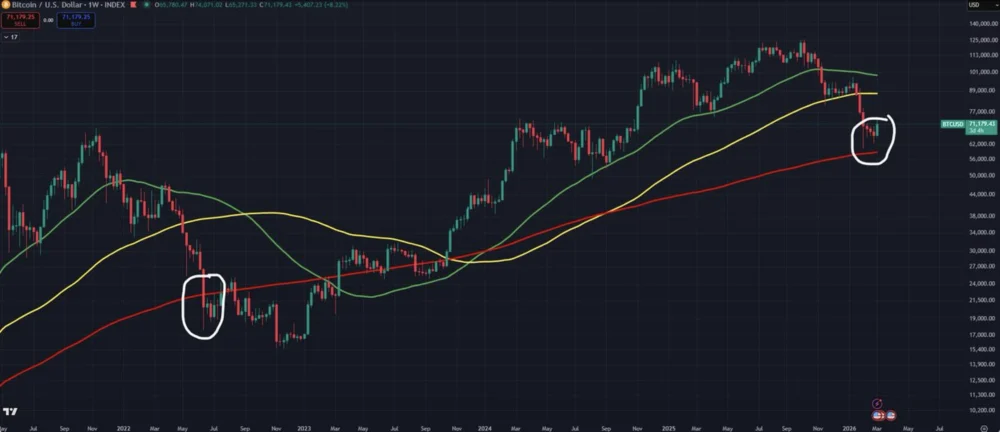
The cryptocurrency market is once again gripped by intense speculation as Bitcoin (BTC) recently pulled back to trade approximately 4.5% below its recent high of $74,000, achieved just days prior on Thursday. This swift retreat has ignited a fierce debate among traders and analysts: does this mark a crucial local top, signaling a potential downward correction, or is it merely a healthy consolidation before Bitcoin embarks on its next leg up towards uncharted territories? The conflicting signals from technical indicators, historical market fractals, and evolving institutional dynamics paint a complex picture for the world’s leading digital asset.
The Bearish Thesis: Echoes of Past Cycles and Liquidity Traps
For a significant segment of the analytical community, the recent surge to $74,000 carries an unsettling resemblance to patterns observed in previous bear cycles, particularly the turbulent year of 2022. This perspective suggests that the current technical structure of BTC, following its robust recovery from the $60,000 mark, mirrors the mid-point behavior of past downturns, where relief rallies often precede further significant declines.
One of the most compelling arguments for a potential local top comes from analyst Bitcoin Hyper, who noted a striking chronological pattern. According to Hyper’s observations, in the previous two market cycles, Bitcoin typically established a local high approximately 140 to 150 days after its all-time high (ATH) before experiencing a subsequent downturn. This pattern appears to be repeating, as Bitcoin’s latest push to $74,000 occurred precisely 149 days after its bull market peak of $126,000, which was recorded in October 2025. This historical correlation suggests that the current rally might be a temporary zenith, destined to recede.

Reinforcing this cautious outlook, pseudonymous trader Bitcoin Isaiah characterized the rally to $74,000 as a "perfect local top indicator." Isaiah’s analysis points to an observable phenomenon where periods of widespread market euphoria and "premature celebrations" by bullish investors frequently precede sharp market corrections. He draws a direct parallel to the 2022 cycle, a period etched into the memory of many crypto participants for its brutal downturn. In that instance, similar market exuberance was swiftly followed by a staggering 68% crash, seeing Bitcoin plummet from approximately $48,200 to a low of $15,500. Isaiah suggests that if history is indeed repeating, Bitcoin could be headed for a revisit to sub-$60,000 levels, testing the resolve of recent buyers.
Adding another layer of bearish sentiment, analyst Master of Crypto described the brief pump above $70,000 as a classic "liquidity trap." In market terms, a liquidity trap occurs when prices are artificially driven up to entice both short-sellers (who are betting on a price decline) and long-buyers (who are betting on a price increase) into positions, only for the price to reverse sharply, liquidating a large number of these leveraged positions. According to Master of Crypto, this maneuver effectively "wiped out both shorts and longs" before the market’s true intention became clear: targeting lower zones. The analyst specifically highlighted the $62,000-$65,000 range as a likely target, where a significant concentration of ask-orders (sell orders) is located. This theory operates on the fundamental principle that "the price usually goes where the bigger money sits," implying that large institutional players or whales manipulate prices to accumulate or distribute assets at advantageous levels.
Furthermore, traditional technical analysis indicators have also flashed warning signs. As previously reported by Cointelegraph, the rally to $74,000 was accompanied by the emergence of a classic bearish chart pattern known as a "death cross." A death cross occurs when a short-term moving average (typically the 50-day exponential moving average or EMA) crosses below a long-term moving average (often the 200-day EMA). This event is widely interpreted by technical analysts as a signal of impending bearish momentum and a potential shift in the market’s overall trend. Coupled with this, the $74,000 level itself presented significant "overhead resistance," a price point where selling pressure is expected to be strong due to a large number of outstanding sell orders or previous price rejections. Overcoming such resistance levels requires substantial buying volume and conviction, which appeared to wane following the initial push.
The Bullish Counter-Narrative: A New Paradigm and Institutional Tailwinds
Despite the compelling arguments for a potential market top, a vocal contingent of bullish analysts and investors asserts that the current cycle is fundamentally different from previous ones, particularly the 2022 bear market. This perspective posits that the $60,000 level was not merely a temporary bounce point but rather a significant market bottom, indicative of a structural shift in Bitcoin’s market dynamics.

Crypto analyst Bitcoin Munger, for instance, explicitly stated that the 2022 Bitcoin bear fractal should not be seen as a "reason to be bearish" in the current environment. Munger’s argument hinges on a critical difference in how Bitcoin interacted with its 200-week exponential moving average (EMA) in the two periods. The 200-week EMA is a widely respected long-term trend indicator, often considered a strong support level in bull markets and a significant resistance in bear markets. In 2022, Bitcoin’s price "cut through" this crucial trend line, signaling a profound capitulation and a deep bear market. In stark contrast, during the recent dip, Bitcoin merely "retested" the 200-week EMA and subsequently bounced decisively. This behavior suggests a robust underlying demand and a stronger market structure, indicating that long-term holders and institutional players stepped in to defend this critical support, preventing a deeper breakdown.
Further supporting the bullish case, analyst Mister Crypto highlights the formation of an "ascending triangle" pattern on the BTC/USD daily chart. An ascending triangle is typically considered a bullish continuation pattern, characterized by a flat top resistance line and an upward-sloping support line. Mister Crypto projects a "strong move to the upside" if the upper trend line, positioned around the $70,000 mark, successfully holds as support after the breakout. The ability of Bitcoin to consolidate above this key psychological and technical level would validate the pattern and potentially clear the path for further gains.
Crucially, the current market environment is distinguished by several significant factors that were largely absent or less pronounced during the 2022 downturn, bolstering the bullish narrative for a sustained rally towards $75,000-$80,000 and potentially beyond.
The Institutional Influx: A Game Changer
Perhaps the most significant differentiator in the current cycle is the unprecedented level of institutional engagement, primarily driven by the introduction of spot Bitcoin Exchange-Traded Funds (ETFs) in major financial markets. Following their approval, these ETFs, managed by giants like BlackRock, Fidelity, and Grayscale, have witnessed robust inflows of capital, transforming the accessibility of Bitcoin for traditional investors. In the weeks leading up to the $74,000 high, these spot Bitcoin ETFs consistently recorded substantial net inflows, with some days seeing hundreds of millions of dollars pour into these investment vehicles. For example, a recent report highlighted $462 million in inflows preceding a surge to $73,000, underscoring the relentless demand from institutional coffers. This continuous absorption of Bitcoin by regulated investment products represents a new and powerful demand vector, fundamentally altering the supply-demand dynamics compared to previous cycles that were more reliant on retail sentiment. These inflows provide a steady, structural buying pressure that can act as a significant buffer against sharp corrections.

Tightening Supply and Halving Dynamics
Compounding the effect of institutional demand is Bitcoin’s inherently scarce supply. The programmatic reduction in new Bitcoin issuance, most notably through its quadrennial "halving" events, ensures that the supply side of the equation becomes increasingly constrained over time. While the most recent halving occurred in April 2024, its effects on reducing new supply into the market are cumulative and long-lasting. This reduction, coupled with the increasing trend of long-term holding (known as "HODLing") by both retail and institutional investors, means that fewer Bitcoins are available on exchanges for active trading. This tightening supply, when met with sustained or increasing demand (especially from ETFs), creates a potent recipe for upward price pressure.
Macroeconomic Context and Global Liquidity
The broader macroeconomic landscape in early 2026 (as implied by the article’s dates) also presents a different backdrop compared to the period preceding the 2022 crash. In 2022, global central banks were aggressively tightening monetary policy, raising interest rates to combat rampant inflation, which led to a significant contraction in global liquidity and a risk-off sentiment across all asset classes, including cryptocurrencies. By early 2026, assuming a more stable inflationary environment and potentially a more accommodative stance from central banks, the tailwinds for risk assets like Bitcoin could be considerably stronger. Increased global liquidity and a search for yield in a potentially lower interest rate environment could push more capital into alternative assets, benefiting Bitcoin.
Implications and The Road Ahead

The current standoff between bullish and bearish narratives underscores the inherent volatility and speculative nature of the cryptocurrency market. For short-term traders, this period demands extreme caution, as the market could swing violently in either direction. A confirmation of the $74,000 level as a local top could lead to a retest of critical support zones, potentially extending down to the $60,000-$65,000 range, or even lower if the bearish fractals play out as predicted. Such a scenario would likely test the conviction of recent buyers and could lead to a temporary cool-off period for the broader altcoin market.
Conversely, if Bitcoin successfully consolidates above key support levels, particularly the $70,000 mark, and then pushes past $74,000 with renewed conviction, it would invalidate many of the bearish arguments. A sustained breakout would likely trigger a fresh wave of buying, driven by both retail FOMO (fear of missing out) and continued institutional accumulation, potentially propelling Bitcoin towards the $75,000-$80,000 range, and perhaps even setting the stage for new all-time highs beyond the $126,000 mark seen in October 2025. This outcome would cement the idea that the current cycle is indeed structurally different, driven by more mature market participants and a robust demand infrastructure.
The coming weeks will be crucial in determining which narrative gains dominance. Market participants will be closely watching trading volumes, ETF flow data, and Bitcoin’s interaction with key technical support and resistance levels. The ongoing evolution of Bitcoin from a niche digital asset to a recognized investment class, supported by institutional frameworks, suggests that while volatility will remain a constant, the underlying long-term trajectory may be shifting towards greater stability and sustained growth. The question remains whether the recent $74,000 peak was a temporary pause for breath or a definitive turning point in Bitcoin’s journey.
This article does not contain investment advice or recommendations. Every investment and trading move involves risk, and readers should conduct their own research when making a decision. While we strive to provide accurate and timely information, Cointelegraph does not guarantee the accuracy, completeness, or reliability of any information in this article. This article may contain forward-looking statements that are subject to risks and uncertainties. Cointelegraph will not be liable for any loss or damage arising from your reliance on this information.