
 admin
admin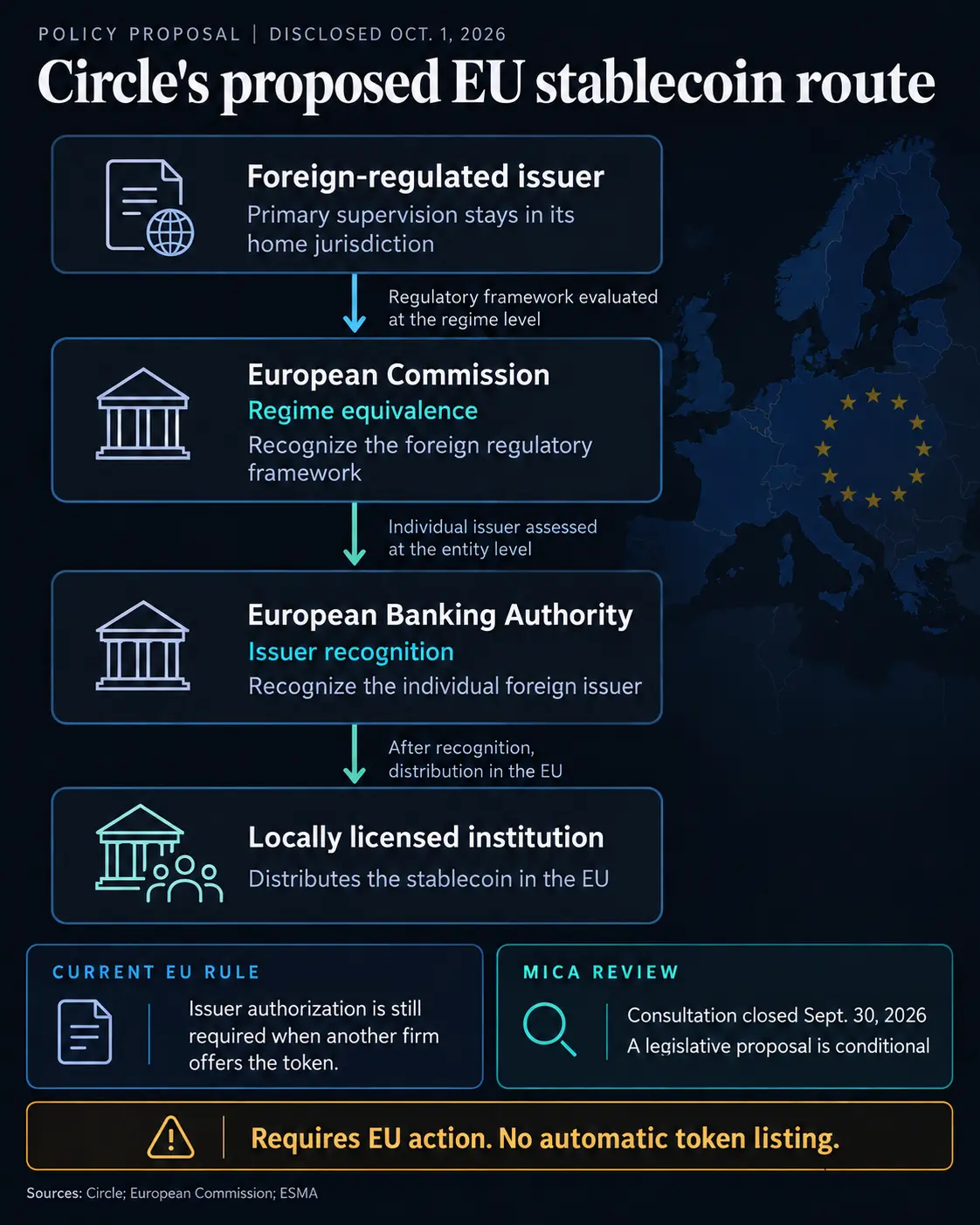
Circle is urging the European Union to open its Markets in Crypto-Assets Regulation (MiCA) to foreign-regulated stablecoins and loosen reserve rules that constrain global issuers. The USDC issuer proposed a recognition regime that could let qualifying overseas stablecoin companies distribute tokens in Europe without becoming fully authorized EU issuers, as part of a broader push to bring more of the global market inside the bloc’s regulatory perimeter. Circle said only three of the world’s 25 largest stablecoins by market value, USDC, USDG and EURC, are currently regulated under MiCA, despite roughly 30 e-money tokens securing authorization since the framework took effect. Under its proposal, the European Commission would first determine whether a foreign jurisdiction’s regulatory regime is equivalent to EU standards. The European Banking Authority (EBA) would then recognize individual issuers, which would remain primarily supervised in their home countries while distributing tokens through locally licensed institutions. That would create an alternative to current MiCA rules, which generally require e-money token issuers seeking public distribution or trading in the bloc to obtain EU authorization. Circle also wants regulators to preserve multi-issuance, where a MiCA-authorized European entity co-issues a globally circulating stablecoin with a foreign-regulated counterpart. The company said restricting that structure risks pushing European users toward offshore platforms and tokens outside MiCA’s protections.
Circle’s proposed EU route requires Commission regime equivalence, EBA issuer recognition and locally licensed distribution; primary home supervision remains, and the MiCA review has not itself established this route.
MiCA Stablecoin Bank Reserve Rule Draws Wider Opposition
Circle is also challenging a requirement that e-money token issuers keep at least 30% of reserves in commercial-bank deposits, rising to 60% for tokens classified as significant. It wants the requirement replaced with a broader liquidity standard, arguing mandatory deposits increase issuers’ exposure to bank credit and counterparty risk. That argument echoes criticism previously made by Tether Chief Executive Officer Paolo Ardoino, who warned that forcing large stablecoin issuers to place substantial reserves in banks could create systemic vulnerabilities if those institutions failed or could not meet large withdrawals. Ardoino said last month that Tether declined to seek an EU license because of the same requirement. The overlap is notable because Circle chose to comply with MiCA while Tether kept USDT outside the framework. Both now argue that requiring stablecoin issuers to concentrate liquidity in commercial banks can introduce risks regulators are seeking to contain.
Circle also wants the EU to remove a 35% cap on exposure to a single sovereign and a rule limiting deposits with an individual bank to 1.5% of that lender’s total assets. It said the restrictions can prevent dollar stablecoins from relying heavily on high-quality sovereign securities and force large issuers to spread reserves across dozens of banks.
Yet regulators are considering tighter controls elsewhere. The EBA last month urged the Commission to strengthen MiCA against risks arising from third-country multi-issuer stablecoin structures, warning that reserves, redemptions and other critical functions can sit beyond effective EU supervision. The Commission’s MiCA review consultation closed Sept. 30, and its findings could lead to legislative amendments. Circle’s recognition proposal therefore offers no immediate route into Europe: foreign issuers remain subject to the existing framework while Brussels decides whether opening MiCA to more global liquidity is worth loosening some of the barriers that kept it out.
The Evolving Landscape of Stablecoin Regulation in the EU
The European Union’s Markets in Crypto-Assets Regulation (MiCA) represents a landmark effort to establish a comprehensive legal framework for crypto-assets within the bloc. Introduced with the aim of fostering innovation, protecting consumers, and ensuring financial stability, MiCA has particular implications for stablecoins, the digital assets pegged to the value of traditional currencies. These stablecoins, crucial for facilitating transactions and providing liquidity within the burgeoning crypto ecosystem, are now subject to stringent requirements designed to mitigate potential risks.

One of the central tenets of MiCA concerning stablecoins, specifically those classified as "e-money tokens," is the mandate for issuers to hold reserves. The regulation stipulates that a significant portion of these reserves must be held in commercial bank deposits. Specifically, at least 30% of reserves must be in such deposits, with this figure rising to 60% for stablecoins deemed "significant" by regulators. This requirement is intended to ensure that stablecoin issuers have readily accessible funds to meet redemption requests and to safeguard against the insolvency of the issuer. The rationale behind favoring bank deposits is their perceived relative safety and liquidity, providing a buffer against market volatility.
However, this specific provision has emerged as a significant point of contention for major global stablecoin issuers, most notably Circle, the issuer of USD Coin (USDC), and Tether, the issuer of USDT. Both companies, which operate on a global scale and have substantial market capitalization, have voiced strong objections to the mandatory bank deposit requirement. Their primary concern is that by concentrating a large portion of their reserves within the traditional banking system, they inadvertently become exposed to the very risks that MiCA is designed to prevent – namely, banking sector instability and counterparty risk.
Circle’s Proposal for a Global Recognition Regime
Circle, a prominent player in the stablecoin market and a regulated entity in various jurisdictions, has put forth a detailed proposal aimed at recalibrating MiCA’s approach to foreign stablecoins. The company’s submission to the European Commission’s MiCA review consultation advocates for the establishment of a "recognition regime." This regime would allow stablecoin issuers regulated in jurisdictions deemed to have equivalent regulatory standards to the EU to operate within the bloc without necessitating full EU authorization.
Under Circle’s proposed framework, the European Commission would be responsible for assessing the equivalence of a foreign jurisdiction’s regulatory regime. Following this assessment, the European Banking Authority (EBA) would then be empowered to recognize individual issuers based on their home-country supervision and regulatory compliance. Crucially, these recognized foreign issuers would continue to be primarily supervised by their domestic regulators. Their operations within the EU would be facilitated through partnerships with locally licensed institutions, effectively creating a pathway for global stablecoins to access the European market while adhering to a framework that acknowledges existing robust regulatory oversight.
Circle highlights that, currently, only a small fraction of the world’s largest stablecoins are compliant with MiCA. As of the latest available data, only three of the top 25 stablecoins by market capitalization—USDC, USDG, and EURC—are regulated under MiCA. This stands in contrast to the approximately 30 e-money tokens that have already secured authorization since MiCA’s implementation. This statistic underscores Circle’s concern that the current stringent requirements are creating a barrier to entry for many established global stablecoins, potentially limiting the availability of regulated options for European users and pushing them towards less regulated offshore alternatives.
Furthermore, Circle’s proposal seeks to preserve the concept of "multi-issuance." This model allows a MiCA-authorized European entity to co-issue a globally circulating stablecoin with a foreign-regulated counterpart. Circle argues that restricting this collaborative structure could inadvertently push European users towards offshore platforms and tokens that fall outside MiCA’s protective umbrella, thereby undermining the regulation’s core objectives of consumer protection and market integrity.
Tether’s Parallel Concerns and Systemic Risk Arguments
The criticisms levied against MiCA’s bank reserve rules are not unique to Circle. Tether, the issuer of the world’s largest stablecoin, USDT, has also expressed significant reservations. Paolo Ardoino, Tether’s Chief Executive Officer, has repeatedly warned that forcing large stablecoin issuers to hold substantial reserves in commercial banks could create significant systemic vulnerabilities. His argument centers on the potential for a domino effect: if a major commercial bank holding significant stablecoin reserves were to face financial distress or collapse, it could trigger a cascade of redemptions that the bank might be unable to meet. This scenario could lead to a loss of confidence in the stablecoin itself, potentially destabilizing broader financial markets.

Ardoino’s stance is particularly noteworthy given Tether’s decision not to seek an EU license under MiCA, explicitly citing the mandatory bank deposit requirement as a primary deterrent. This position, from an issuer that has historically operated with less stringent regulatory oversight than some of its competitors, signals a shared concern about the practical implications of MiCA’s reserve requirements, even from entities with different compliance strategies. The fact that both Circle, which has actively sought regulatory compliance, and Tether, which has largely remained outside stringent regulatory frameworks, find common ground on this specific issue lends considerable weight to their arguments. They contend that requiring stablecoin issuers to concentrate liquidity in a limited number of commercial banks introduces a concentration of risk that regulators are ostensibly trying to mitigate.
A Deeper Dive into Reserve Requirements and Liquidity Standards
Beyond the general concern about bank deposits, Circle has also flagged specific quantitative restrictions within MiCA’s reserve framework. The regulation includes a 35% cap on exposure to a single sovereign entity and a strict limit of 1.5% of a bank’s total assets for deposits held with an individual lender. Circle argues that these limitations hinder dollar-denominated stablecoins from effectively utilizing high-quality sovereign securities, which are typically considered safe and liquid assets. Moreover, these rules can force large issuers to diversify their reserves across a multitude of banks, potentially increasing operational complexity and reducing the efficiency of reserve management.
The rationale behind these caps is likely to prevent over-reliance on a single financial institution or government, thereby diversifying counterparty risk. However, critics like Circle suggest that these restrictions may be overly prescriptive and could inadvertently limit the flexibility and efficiency of stablecoin issuers in managing their reserves, particularly for those aiming for broad international accessibility.
Regulatory Scrutiny Intensifies
While stablecoin issuers are pushing for a more flexible regulatory approach, European regulators are simultaneously exploring avenues to strengthen MiCA’s oversight. The EBA, in its recent recommendations, has called for enhancements to MiCA to address risks emanating from third-country multi-issuer stablecoin structures. The authority has expressed concerns that critical functions such as reserve management, redemption processes, and overall operational oversight can reside outside the effective supervisory reach of the EU when dealing with stablecoins issued by entities based abroad. This suggests a regulatory inclination towards tighter controls, especially for stablecoins with significant exposure to European users but issued and managed elsewhere.
The European Commission’s MiCA review consultation concluded on September 30th. The findings from this review are expected to inform potential legislative amendments. The industry is now awaiting the Commission’s decision on whether to consider Circle’s proposed recognition regime or other modifications to the existing framework. The outcome will be pivotal in shaping the future of stablecoin operations within the EU, determining whether the bloc opts for a more inclusive approach that accommodates global players or maintains a more protectionist stance with stricter adherence to its established rules.
Broader Implications for the Global Stablecoin Market
The debate surrounding MiCA’s stablecoin regulations has far-reaching implications beyond the European Union. As a major economic bloc, the EU’s regulatory decisions often set precedents for other jurisdictions. If MiCA were to adopt a more accommodating stance towards foreign-regulated stablecoins, it could encourage similar approaches in other countries, fostering a more interconnected and efficient global stablecoin market. Conversely, a rigid adherence to the current rules might lead to further fragmentation, with different regulatory regimes creating distinct operational challenges for global issuers.
The tension between ensuring robust consumer and investor protection and fostering market innovation is a delicate balancing act. The EU’s MiCA framework represents an ambitious attempt to strike this balance. However, the feedback from key industry players like Circle and Tether suggests that certain provisions, particularly those concerning reserve requirements, may require recalibration to align with the operational realities and global nature of the stablecoin ecosystem. The coming months will be crucial in observing how European regulators respond to these concerns and whether they can devise a regulatory framework that is both secure and conducive to the continued growth and integration of stablecoins into the global financial landscape. The current dialogue highlights a critical juncture where the EU has the opportunity to shape not only its own digital asset market but also influence the trajectory of stablecoin regulation worldwide.








