Nila Kartika Wati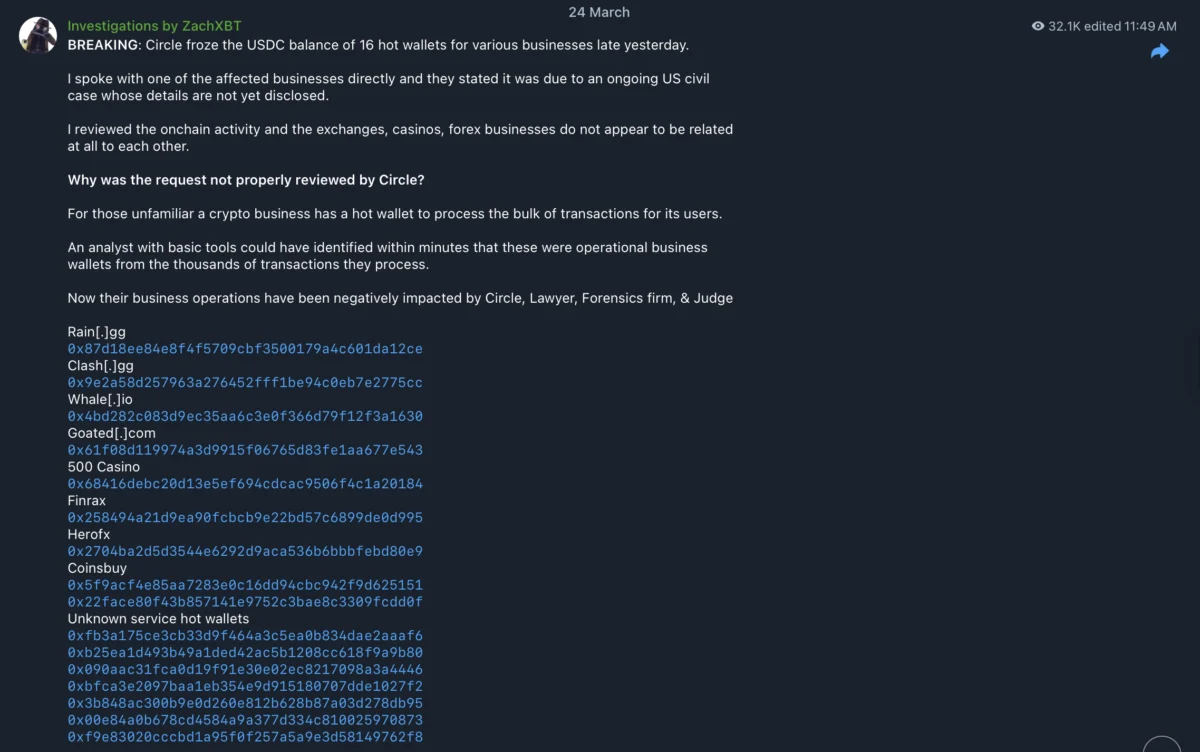
Stablecoin issuer Circle, the company behind the widely used USD Coin (USDC), has come under significant scrutiny following allegations that it wrongfully froze 16 distinct crypto wallets. The action, reportedly taken in connection with an ongoing and sealed civil legal case in the United States, has drawn sharp criticism from prominent on-chain investigator and security researcher ZachXBT, who characterized the freeze as potentially one of the most incompetent in recent memory. The incident reignites long-standing debates within the cryptocurrency community regarding the centralized nature of certain stablecoins and their susceptibility to external control, contrasting sharply with the foundational principles of decentralization and censorship resistance inherent to much of the crypto ecosystem.
The core of the controversy centers on the identification and subsequent freezing of these wallets. According to ZachXBT’s findings, shared across his Telegram channel and social media, the frozen wallets belonged to a diverse array of operational entities, including various crypto exchanges, online casinos, and foreign currency exchange businesses. Crucially, the investigator asserted that these entities "do not appear related at all" to each other or to the presumed subject of the sealed civil case. ZachXBT further emphasized the apparent lack of due diligence, stating, "An analyst with basic tools could have identified, within minutes, that these were operational business wallets from the thousands of transactions they process." This highlights a potential failure in the identification process, suggesting that the scale and nature of transactions on these wallets should have clearly indicated their legitimate, high-volume business operations, distinguishing them from illicit or personal funds.
The Allegations and Investigator’s Findings
ZachXBT, renowned for his extensive work in tracking illicit funds and exposing scams across various blockchain networks, brought the matter to public attention through a series of posts. His investigation revealed that the directive for the freeze stemmed from a U.S. civil legal case, the details of which remain sealed. The sealed nature of the case implies that information, including the specific allegations or parties involved, is not publicly accessible, often to protect ongoing investigations, sensitive corporate information, or individual privacy. While such legal mechanisms are standard in traditional jurisprudence, their application to the transparent and often immutable world of blockchain assets introduces unique complexities and raises questions about accountability and due process, especially when third-party assets are inadvertently caught in the crossfire.
The investigator’s pointed criticism was not limited to the identification process. He specifically stated that Circle had "zero basis" to freeze the fiat-pegged tokens held in these wallets, implying a severe overreach or a profound misunderstanding of the assets’ provenance. In a particularly strong condemnation, ZachXBT remarked, "In my 5-plus years of investigations, it could potentially be the single most incompetent freeze I have seen. This is what happens when you outsource your freezing decisions to literally any random federal judge instead of having a process." This statement suggests a systemic issue, positing that Circle might be relying too heavily on external judicial orders without implementing robust internal verification protocols to ensure the accuracy and appropriateness of such drastic actions. The implication is that a more rigorous internal review, leveraging on-chain analytical expertise, could have prevented the alleged erroneous freeze, thereby safeguarding legitimate businesses from unwarranted financial disruption.
Cointelegraph reached out to Circle for comment regarding ZachXBT’s claims but did not receive a response by the time of publication, leaving the stablecoin issuer’s perspective and justification for the actions undisclosed. This lack of official comment further fuels speculation and concern within the community, as it leaves critical questions unanswered regarding the specifics of the court order, Circle’s internal procedures for compliance, and any recourse available to the affected wallet holders.
Understanding Stablecoins and Centralized Control
USDC, issued by Circle, is a prominent stablecoin designed to maintain a 1:1 peg with the U.S. dollar. It is the second-largest stablecoin by market capitalization, playing a critical role in facilitating liquidity, trading, and transfers within the broader cryptocurrency ecosystem. Unlike decentralized cryptocurrencies such as Bitcoin or Ethereum, which are designed to operate without a central authority, centralized stablecoins like USDC operate under the purview of their issuing entities. This centralization, while offering certain benefits such as regulatory compliance and potential stability, inherently grants the issuer the technical capability to freeze assets. This is achieved by blacklisting specific wallet addresses on the underlying blockchain protocol (in USDC’s case, primarily Ethereum), effectively preventing the movement of tokens from those addresses.

The ability of an issuer to freeze assets is a double-edged sword. On one hand, it is often touted as a necessary tool for combating illicit activities, complying with sanctions, and responding to legal mandates from authorities. It provides a mechanism for law enforcement to recover stolen funds or prevent their further dissemination. On the other hand, this very capability fundamentally contradicts the core ethos of many cryptocurrencies, which champion permissionless access, censorship resistance, and individual sovereignty over assets. Critics argue that when an issuer can unilaterally freeze funds, the assets are not truly "owned" by the holder in the same sense as physical cash or a truly decentralized digital asset. This distinction becomes particularly stark in cases where the freezes are alleged to be erroneous or without clear, publicly transparent justification.
The Legal Context: Sealed Cases and Due Process
The reference to a "sealed" U.S. civil legal case adds a layer of complexity and opacity to the situation. Sealed court documents or cases are not uncommon in the U.S. legal system, serving various purposes such as protecting trade secrets, sensitive personal information, or ongoing investigations that could be jeopardized by public disclosure. However, when such a sealed order leads to the freezing of digital assets, especially those belonging to seemingly unrelated third parties, it raises significant concerns about due process and transparency.
In traditional finance, asset freezes typically involve a bank or financial institution being ordered to block accounts. While inconvenient, there are established legal avenues for affected parties to challenge such orders, often with relatively clear judicial oversight and public record. In the context of crypto, where transactions are global and often pseudonymous, and the legal frameworks are still evolving, the process can be far less straightforward. The lack of public information about the sealed case makes it difficult for the affected businesses to understand the basis for the freeze, challenge its legitimacy effectively, or seek immediate recourse. This situation underscores a growing tension between traditional legal enforcement mechanisms and the novel characteristics of digital assets, particularly regarding the rights of innocent third parties caught in cross-border legal actions.
Industry Reactions and Broader Concerns
The incident quickly resonated within the cryptocurrency community, prompting a wave of reactions from industry leaders and commentators who have long warned about the implications of centralized control over digital assets. Mert Mumtaz, founder of the remote procedure call (RPC) node provider Helius, succinctly captured a prevailing sentiment, stating, "This is your 10th reminder that centrally issued stablecoins are not actually yours; they can be frozen, unlike cash." His comment directly challenges the perception of stablecoins as an equivalent to holding physical cash, emphasizing the inherent vulnerability to external control that comes with trusting a central issuer.
The discussion also extended to the broader political landscape and the ongoing debate surrounding central bank digital currencies (CBDCs) and stablecoin regulation. Jean Rausis, co-founder of the Smardex decentralized trading platform, voiced concerns that provisions within regulatory frameworks, such as the proposed GENIUS stablecoin bill in the U.S., could inadvertently pave the way for a "privately managed central bank digital currency." Rausis argued that centralized stablecoins effectively bestow upon their issuers the same level of financial surveillance and asset-freezing capabilities that a standard CBDC would inherently possess. This perspective frames the current incident not just as an operational mishap but as a tangible illustration of the potential for broad financial control if digital currencies are designed with centralized governance structures.
Echoing these concerns, former U.S. lawmaker Marjorie Taylor Greene had previously warned in May 2025 that regulated stablecoins, particularly under the GENIUS bill, could serve as a "CBDC Trojan Horse." Her statement highlights a significant faction of political thought that views centralized digital currencies, whether privately or publicly issued, with suspicion, fearing they could erode financial privacy and enable unprecedented government oversight and control over individual financial transactions. The Circle incident, therefore, serves as a stark reminder of the practical implications of these theoretical debates, bringing the abstract concept of "control" into sharp relief for real businesses operating in the crypto space.
The Decentralization Dilemma

This event underscores a fundamental dilemma at the heart of the cryptocurrency movement: the tension between regulatory compliance and the ethos of decentralization. While regulators and traditional financial institutions often advocate for centralized control over stablecoins to ensure stability, combat illicit finance, and protect consumers, proponents of decentralization argue that such control undermines the very principles that make cryptocurrencies revolutionary. The promise of crypto often lies in its ability to offer permissionless, censorship-resistant transactions, giving individuals and entities greater autonomy over their financial assets. When an issuer can freeze funds, even under legal mandate, it introduces a point of centralized failure and potential censorship, regardless of the intent.
For many, the ability to freeze assets, even in cases of legitimate legal proceedings, represents a slippery slope. If legitimate businesses can have their operational funds frozen due to what ZachXBT describes as "incompetent" identification, it erodes trust in the stability and reliability of centralized stablecoins as a medium for commerce. It pushes users towards truly decentralized alternatives or self-custody solutions, where the risk of such third-party intervention is minimized.
Implications for Users and Businesses
The implications of such alleged wrongful freezes are far-reaching, especially for businesses that rely on USDC for their operations. Crypto exchanges, online casinos, and foreign currency exchange businesses often handle substantial volumes of transactions daily. A freeze on their operational wallets can cripple their ability to conduct business, fulfill customer orders, process withdrawals, and manage liquidity. This can lead to significant financial losses, reputational damage, and a loss of trust among their user base. For smaller businesses, an extended freeze could even threaten their solvency.
Furthermore, the lack of transparency surrounding sealed legal cases means affected businesses might be left in the dark, struggling to understand why their funds have been frozen and what steps they can take to rectify the situation. This creates an environment of uncertainty and risk, potentially deterring legitimate businesses from adopting centralized stablecoins for fear of arbitrary or erroneous intervention. It also highlights the critical need for clear communication channels and robust dispute resolution mechanisms when such incidents occur.
Call for Transparency and Best Practices
The incident unequivocally calls for greater transparency from stablecoin issuers like Circle and a reevaluation of their internal processes for complying with legal orders. While legal compliance is non-negotiable, the manner in which it is executed can have profound impacts on the broader ecosystem. Implementing more sophisticated on-chain analysis tools and human oversight before executing a freeze, especially on high-volume operational wallets, could significantly reduce the risk of erroneous actions. A process that prioritizes due diligence and verifies the actual nature of the funds and their owners would serve to protect legitimate actors while still enabling effective action against illicit activities.
Moreover, the crypto community will likely continue to advocate for more transparent legal frameworks that balance the need for law enforcement with the fundamental rights of asset holders, particularly in cases involving sealed orders. Clearer guidelines on how stablecoin issuers should respond to such orders, coupled with mechanisms for swift redress for wrongfully affected parties, are essential for fostering trust and ensuring the continued growth and legitimacy of the digital asset economy.
In conclusion, the alleged wrongful freezing of 16 USDC wallets by Circle, as reported by ZachXBT, represents a critical juncture in the ongoing dialogue surrounding centralized stablecoins. It serves as a potent reminder of the inherent trade-offs between regulatory compliance and the core tenets of decentralization. As the digital asset landscape matures, incidents like this underscore the urgent need for stablecoin issuers to refine their operational protocols, enhance transparency, and uphold the principles of fairness and due process, ensuring that the promise of digital finance is realized without compromising the foundational values of the cryptocurrency movement.