
 admin
admin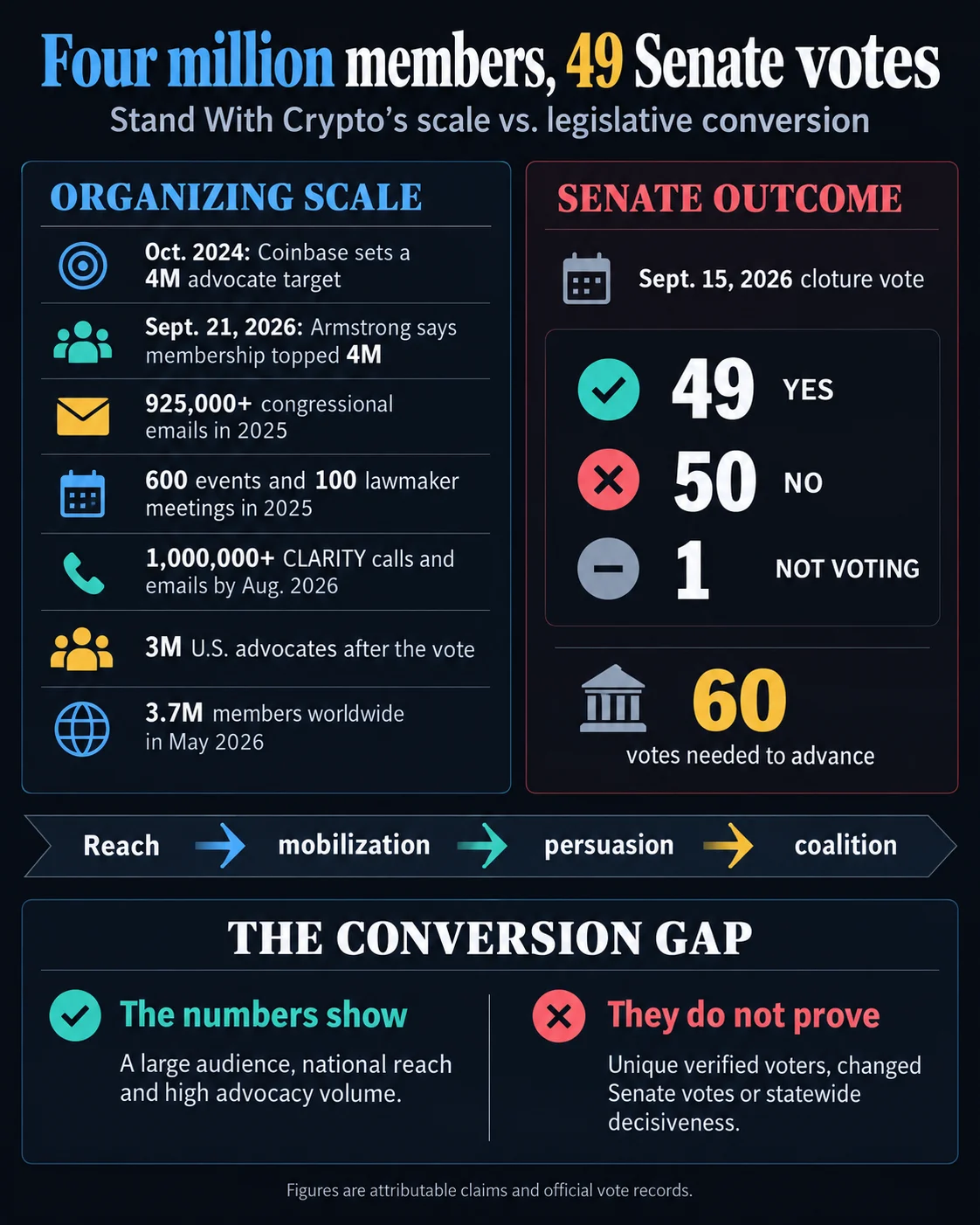
The United States Senate’s recent failure to advance the CLARITY Act on September 15th, with a cloture vote falling short at 49-50, has cast a spotlight on the burgeoning influence of crypto advocacy groups. While the legislative setback underscores the complexities of bipartisan consensus-building in Congress, it coincides with a significant milestone for "Stand With Crypto," an organization backed by Coinbase. Just six days after the Senate vote, Coinbase CEO Brian Armstrong announced that Stand With Crypto had surpassed four million members, a figure he later emphasized as crucial for future elections.
Armstrong’s public statement, made via social media, highlighted the perceived importance of the "crypto voter" in the 2024 election cycle, suggesting that this demographic would hold elected officials accountable for their stances on digital assets. However, the proximity of the Senate’s procedural vote on H.R. 3633, the CLARITY Act, to Stand With Crypto’s membership surge raises critical questions about the translation of broad supporter lists into tangible legislative influence. The Senate’s decision concerned the initiation of debate on the bill, not its ultimate passage or the efficacy of any single advocacy group. This distinction places Stand With Crypto’s central political challenge in sharp focus: converting a substantial base of supporters into the bipartisan votes necessary to enact policy changes.
The Metrics of Stand With Crypto’s Four Million Members
Brian Armstrong’s announcement marked the culmination of a strategic objective set forth by Coinbase. In October 2024, the cryptocurrency exchange publicly committed to supporting Stand With Crypto’s goal of reaching four million advocates by the 2026 midterm elections. This pledge was not an isolated initiative; Coinbase had been instrumental in the creation of the organization in 2023, clearly integrating membership growth into its broader policy advocacy strategy.
While Armstrong used the term "members," Stand With Crypto has also employed "advocates" to describe its growing network. Following the Senate vote, the organization quantified its U.S. network at three million advocates. Earlier in May, Stand With Crypto reported a global membership exceeding 3.7 million across six international markets. It is important to note that these figures represent distinct snapshots in time and geographical scope, meaning they do not constitute a singular, continuous growth series and are not inherently contradictory. Crucially, these numbers cannot be directly equated to four million verified American voters who are actively engaged in the political process.
The privacy policy of Stand With Crypto offers some insight into how its membership is defined, encompassing individuals who are members, subscribers, account holders, those whose information is received from partners, and participants in advocacy activities. However, the policy does not provide granular details on the deduplication of this headline count, the management of inactive records, or the precise number of participants who are verified U.S. voters. Therefore, the four-million claim primarily signals the organization’s reach and potential for mobilization, while its true electoral impact hinges on distinctions that the organization has not yet fully quantified.
Coinbase has confirmed its role in launching Stand With Crypto and setting the ambitious four-million target, underscoring a deep strategic and operational alignment between the two entities. The total funding allocated to Stand With Crypto by Coinbase, or any other industry coalition, has not been publicly disclosed. While Stand With Crypto may benefit from broader industry support, its recent membership milestone is undeniably tethered to a specific Coinbase objective. Membership numbers serve as a valuable benchmark for organizing efforts, but they do not, in isolation, reveal the intensity of support, the eligibility of participants, or the geographic leverage behind the aggregated count. The true measure of its electoral impact will depend on whether future membership gains translate into deepened electoral leverage or simply enlarge the pool of individuals available for future outreach campaigns.
Mobilization Efforts: Visible Actions, Unquantified Outcomes
Stand With Crypto has provided data suggesting significant engagement from its supporters. The organization reported that its advocates sent over 925,000 emails to Congress in 2025. This period also saw the organization facilitate 600 events and conduct 100 meetings with lawmakers. By August 2026, Stand With Crypto claimed that its advocacy efforts related to the CLARITY Act had generated over one million calls and emails directed at congressional offices.
These figures demonstrate Stand With Crypto’s capacity to stimulate political action on a considerable scale. A supporter list accrues greater value when individuals actively use it to contact their representatives, attend rallies, or organize at the local level. Furthermore, Stand With Crypto offers geographic breakdowns of its advocates by U.S. House district, providing a structural map of its network rather than a singular national aggregate.

Despite these visible mobilization efforts, the organization has not disclosed crucial details such as the number of unique individuals who generated the reported calls and emails, the extent of responses from congressional offices, whether undecided senators shifted their positions as a result of the outreach, or which specific arguments proved most influential. The district-level totals, while informative for targeted outreach, do not reveal whether these individuals are registered voters, how strongly they prioritize cryptocurrency issues, or their potential to sway statewide Senate contests. The official roll call vote for the CLARITY Act on the Senate floor recorded 49 votes in favor of cloture and 50 against, with one senator abstaining. This outcome suggests that over one million claimed bill-related contacts did not translate into the necessary bipartisan coalition to overcome the 60-vote threshold required for legislative advancement.
The metrics provided by Stand With Crypto effectively capture supporter acquisition and demonstrated activity. However, legislative success hinges on persuading lawmakers capable of bridging partisan divides. Quantifiable data on unique participants, direct responses from congressional offices, and shifts in voting intentions would establish a more direct correlation between outreach volume and actual political movement. This distinction is also critical for evaluating the organization’s district-level network. While House district totals can inform localized event planning and constituent engagement strategies, the power to influence Senate legislation is measured on a statewide basis. A truly politically impactful map must delineate not only the presence of supporters within a database but also the concentration of verified, engaged voters who possess the potential to influence lawmakers whose votes remain undecided.
The CLARITY Act: Beyond an Ethics Dispute
The legislative debate surrounding the CLARITY Act was multifaceted, extending beyond initial ethical considerations. Democratic opponents frequently raised concerns regarding presidential ethics, particularly focusing on the cryptocurrency interests of President Donald Trump’s family. Members of the Senate Banking Committee, including prominent figures like Senator Elizabeth Warren, argued that the proposed regulatory restrictions contained significant loopholes and lacked robust enforcement mechanisms.
Senator Elissa Slotkin, a Democrat from Michigan, articulated her opposition to the bill by citing concerns related to ethics, anti-money-laundering safeguards, national security implications, and the capacity of the Commodity Futures Trading Commission (CFTC) to effectively oversee the digital asset market. Her position underscored a broader Democratic apprehension that the bill did not adequately address the potential risks associated with the rapidly evolving cryptocurrency landscape.
On the Republican side, Senator Susan Collins of Maine described the CLARITY Act as a "moving target" that had expanded to over 600 pages, suggesting a lack of clarity and conciseness in its legislative framework. She also voiced concerns that the proposed stablecoin reward mechanisms could potentially divert deposits away from community banks and credit unions, thereby impacting the stability of traditional financial institutions. Banking industry groups echoed these sentiments, arguing that a proposed regulatory "circuit breaker" mechanism would only address yield-driven deposit flight after substantial harm had already occurred, indicating a reactive rather than proactive approach to financial stability.
Implications and Future Outlook
Stand With Crypto has demonstrably succeeded in building a substantial advocacy audience and in directing political outreach efforts. The organization has shown its ability to mobilize individuals to contact their representatives, participate in events, and engage in political discourse. The challenge now lies in substantiating its claim that its four million members constitute a verified voter bloc capable of delivering decisive outcomes in Senate races.
The distinction between a large supporter list and a politically potent electorate is crucial. While the former signifies reach and potential, the latter demands evidence of active engagement, voter registration, and a demonstrated willingness to translate advocacy into electoral action. The CLARITY Act’s failure to advance in the Senate, despite significant advocacy efforts, serves as a potent reminder that legislative success requires more than just a large number of interested individuals. It necessitates a nuanced understanding of the political landscape, the ability to forge bipartisan consensus, and the capacity to persuade lawmakers on complex policy issues.
The future effectiveness of organizations like Stand With Crypto will likely depend on their ability to provide more granular data on their supporters’ engagement, voting status, and geographic influence. This data will be essential for demonstrating to lawmakers that their advocacy efforts translate into meaningful electoral pressure. As the cryptocurrency industry continues to mature and its presence in the broader economy grows, the role of organized advocacy will undoubtedly remain significant. However, the path to legislative success will require a sophisticated approach that bridges the gap between online mobilization and tangible political influence, ensuring that the voices of crypto advocates are not only heard but also demonstrably impactful in shaping policy. The journey from four million claimed members to four million impactful voters remains a critical, and as yet uncompleted, chapter in the evolving political landscape of digital assets.








