admin
admin
The landscape of American financial derivatives is undergoing a seismic shift as Kalshi, a leading prediction market platform, reports unprecedented growth in both user engagement and financial activity. Over the past year, the platform has transitioned from a niche financial tool into a high-traffic powerhouse, even as it navigates a complex web of regulatory scrutiny and high-stakes litigation. Recent data indicates that Kalshi’s domestic web traffic has surged by more than 1,500%, while its notional trading volume has outpaced that growth, signaling a profound change in how retail and institutional participants interact with event-based contracts.
According to data from Similarweb, Kalshi recorded approximately 15.4 million visits from users within the United States in July 2026. This represents a staggering 1,520% increase compared to the figures from August 2025, when the platform saw just under 1 million visits. This domestic surge is particularly notable given that U.S. traffic now accounts for nearly 80% of the platform’s total global engagement, up from 72.8% a year prior. This concentration of growth highlights Kalshi’s successful, albeit controversial, penetration of the American market at a time when the legal definition of "event contracts" is being debated in the highest courts of the land.
A Surge in Market Participation and Notional Volume
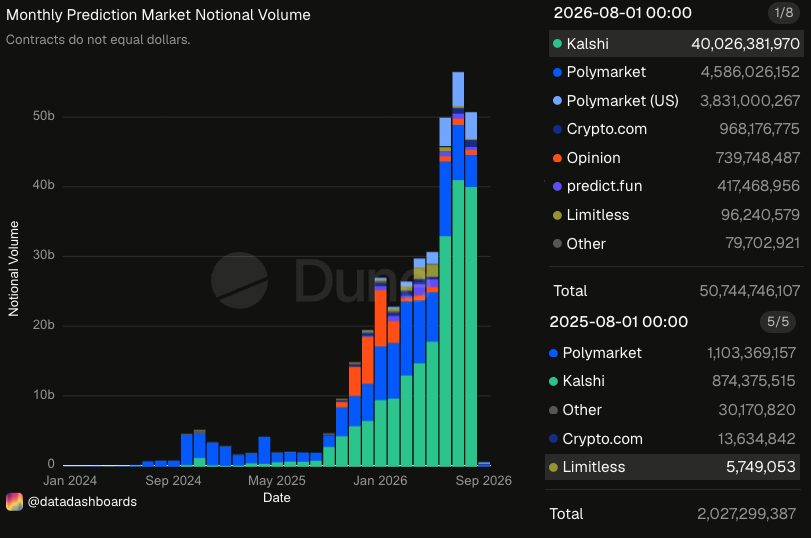
While the increase in web traffic is significant, the explosion in trading activity is even more pronounced. Data from Dune Analytics reveals that Kalshi’s monthly notional trading volume reached approximately $40 billion in August 2026. To put this in perspective, the platform’s volume in August 2025 stood at a relatively modest $874 million. This represents an approximate 4,500% increase in financial throughput over a twelve-month period.
The broader prediction market industry has experienced a similar, though slightly less aggressive, upward trajectory. Total monthly notional volume across the entire sector rose to $50.7 billion, up from roughly $2 billion the previous year. Kalshi’s $40 billion contribution means it now commands nearly 79% of the total market share for prediction market volume. This dominance is largely attributed to the platform’s aggressive expansion into sports-related contracts, which reportedly accounted for 83% of its total trading volume in July 2026.
Analysts suggest that the discrepancy between traffic growth (1,520%) and volume growth (4,500%) indicates a maturing user base. While more people are visiting the site, those who are trading are doing so with significantly higher frequency or larger capital allocations. This trend suggests that Kalshi is moving beyond mere curiosity and is increasingly being utilized as a serious venue for hedging and speculation.
The Legal Battlefront: Federal Oversight vs. State Gambling Laws
Kalshi’s rapid ascent has not occurred in a vacuum. The platform is currently the focal point of a jurisdictional tug-of-war between federal regulators, state authorities, and the judiciary. The core of the dispute centers on whether Kalshi’s event contracts—specifically those tied to the outcomes of sporting events and political elections—constitute regulated financial derivatives or illegal gambling.

The Commodity Futures Trading Commission (CFTC) has historically maintained a cautious stance toward prediction markets, often arguing that contracts involving "gaming" or activities "contrary to the public interest" should be prohibited. However, Kalshi’s status as a Designated Contract Market (DCM) gives it a unique standing that it has used to push the boundaries of traditional commodities trading.
The legal pressure reached a fever pitch recently when New Jersey authorities took their dispute to the U.S. Supreme Court. State regulators argue that Kalshi’s sports contracts circumvent state-level gambling protections and tax frameworks. This sentiment is echoed in Michigan, where authorities have continued a persistent pursuit to block the platform’s operations, fearing that the lack of traditional "house" oversight found in casinos could lead to market manipulation or consumer harm.
Kalshi, conversely, argues that its platform provides essential economic utility. By allowing users to trade on the outcome of real-world events, the platform facilitates "price discovery" and offers a way for businesses and individuals to hedge against specific risks that traditional insurance or stock markets cannot cover.
Chronology of Regulatory Friction and Platform Evolution
The path to Kalshi’s current market dominance has been marked by several key milestones:
- Early 2021: Kalshi receives approval from the CFTC as a Designated Contract Market, allowing it to list event contracts.
- 2023–2024: The platform attempts to list contracts on U.S. Congressional control, leading to a direct legal confrontation with the CFTC. The regulator initially blocks the contracts, but Kalshi seeks redress in federal court.
- Late 2024: A series of court rulings begins to lean in favor of prediction markets, arguing that the CFTC exceeded its statutory authority in banning certain types of event contracts.
- June 2025: Kalshi announces a strategic partnership with the Canadian financial services firm Wealthsimple. This move allows nearly 4,000 Kalshi contracts to be accessed by Canadian users through a separate, compliant application, despite Kalshi’s main platform remaining restricted in the region.
- Early 2026: The explosion of sports contracts. As Kalshi diversifies its offerings to include play-by-play and game-outcome contracts, trading volume begins its exponential climb.
- Mid-2026: The New Jersey Supreme Court filing marks the first time the specific issue of prediction markets vs. state gambling law has been elevated to the highest level of the U.S. judiciary.
Global Interest and Restricted Jurisdictions
Interestingly, Kalshi’s growth is not confined to the jurisdictions where it is fully authorized to operate. Web traffic data shows a significant increase in visits from countries where the platform’s member agreement explicitly prohibits direct trading.
In Canada, visits to Kalshi’s website jumped to 450,000 in July 2026, up from 50,000 a year earlier. Similarly, the United Kingdom saw traffic rise to 296,000 from 31,000 over the same period. While these figures represent a smaller percentage of total traffic than the U.S. (with Canada at 2.3% and the UK at 1.5%), the growth rate remains high.
The traffic from Canada is largely explained by the Wealthsimple partnership, which provides a legitimate pipeline for Canadian capital into Kalshi’s markets. However, the UK traffic remains more enigmatic. It suggests a high level of international interest in the "information signals" generated by Kalshi’s markets. Even users who cannot legally trade often use the platform as a source of real-time data, viewing the "odds" on Kalshi as more accurate than traditional polling or expert analysis.
The "Wisdom of the Crowd" and Economic Implications
The rise of Kalshi is part of a broader trend toward the financialization of information. Proponents of prediction markets argue that they are the most efficient way to aggregate disparate information. In this view, when people "put their money where their mouth is," the resulting market price is a more reliable predictor of future events than any other metric.
This has profound implications for various sectors:
- Political Polling: As prediction markets grew during the 2024 and 2026 cycles, many observers began to favor market prices over traditional polls, which have struggled with sampling bias in recent years.
- Corporate Risk Management: Companies can use Kalshi to hedge against specific legislative outcomes, such as changes in the corporate tax rate or the passing of environmental regulations.
- Sports Integrity: The massive volume in sports contracts has led to calls for increased transparency. If a market moves sharply without an obvious reason, it can serve as a "red flag" for potential match-fixing or insider information leaks.
Future Outlook and the Looming Supreme Court Decision
As Kalshi continues to scale, the shadow of the U.S. Supreme Court looms large. A decision in the New Jersey case could set a definitive precedent for the entire industry. If the Court rules that event contracts are a form of gambling, Kalshi could be forced to seek licenses on a state-by-state basis, a move that would drastically increase operational costs and potentially fragment the liquidity that makes the platform so successful.
On the other hand, a ruling that affirms the CFTC’s sole jurisdiction over these markets would provide Kalshi with a "regulatory moat," solidifying its position as a federally regulated exchange and potentially opening the door for even more institutional involvement.
For now, the platform shows no signs of slowing down. With its traffic and volume reaching record highs, Kalshi has proven that there is a massive appetite for event-based trading. Whether the legal infrastructure can evolve fast enough to accommodate this new asset class remains the $40 billion question.
As the industry awaits the next judicial and regulatory developments, the data remains clear: prediction markets have moved from the periphery of finance to the mainstream, and Kalshi is currently the engine driving that transition. The coming months will determine whether this growth is a sustainable evolution of the financial markets or a bubble that will be curtailed by the hammer of the law.