James Watt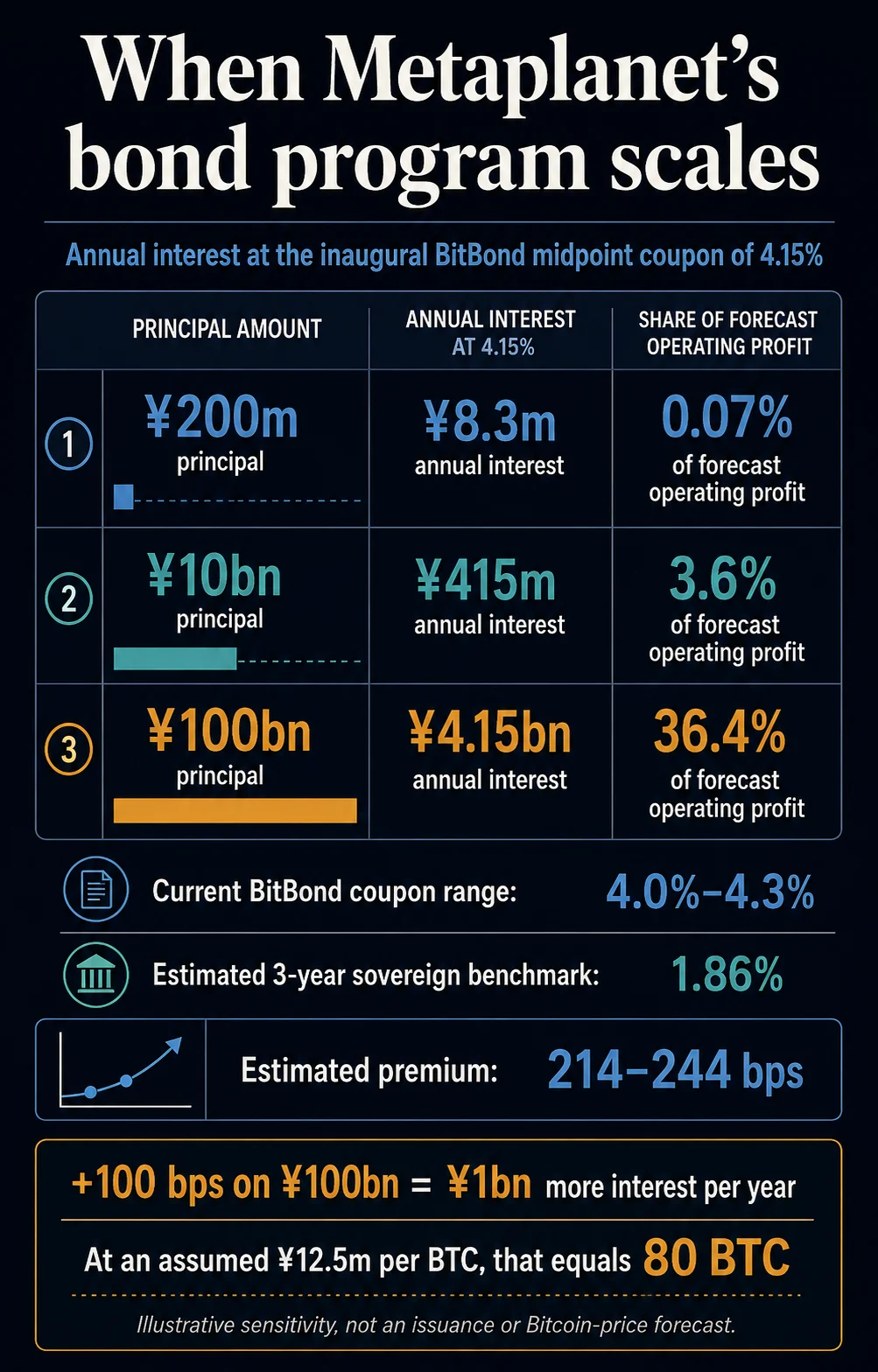
Japan’s 30-year government-bond auction cleared at a 4.079% average yield on September 3, marking a significant shift in the nation’s fixed-income landscape and signaling a more challenging environment for corporations seeking long-term capital. For Metaplanet, the Tokyo-listed firm that has aggressively pivoted to a Bitcoin-treasury model, the rise in sovereign yields serves as a critical benchmark for its future financing costs. While the long bond acts as a primary market signal for the broader economy, the more immediate pressure for Metaplanet lies in the pricing of shorter-tenor debt and the looming requirements for refinancing existing obligations.
The recent auction results highlight a notable upward trend in borrowing costs across the Japanese archipelago. The average yield of 4.079% represents a jump of 14.2 basis points from the 3.937% recorded at the previous 30-year auction on August 6. This movement is not isolated to the long end of the curve; Japan’s September 1 auction for 10-year bonds saw an average yield of 2.995%. While the 4% threshold currently remains at the long end rather than across the entire yield curve, the trajectory suggests a steady departure from the ultra-low interest rate environment that has characterized the Japanese economy for decades. Concurrently, the Bank of Japan (BoJ) maintains an operating guideline of approximately 1% for the uncollateralized overnight call rate, creating a steepening yield curve that complicates the capital-raising efforts of firms utilizing debt to acquire volatile digital assets.
The Architecture of Metaplanet’s Debt and Capital Strategy
Metaplanet’s current financial structure is a mosaic of fixed obligations and equity-linked instruments designed to facilitate its transition into a "Bitcoin-standard" company. At present, the company’s existing fixed obligations remain insulated from immediate market fluctuations due to their contractual terms. The firm’s 20th-series ordinary bond, valued at ¥8 billion, is a zero-coupon instrument maturing on April 23, 2027. Because it carries no annual interest payment, it protects the company’s near-term cash flow, allowing it to direct capital toward Bitcoin accumulation rather than debt servicing.
However, the company’s inaugural "BitBonds"—the 21st through 24th series—present a different set of economic variables. These bonds, totaling ¥200 million, carry fixed coupons ranging from approximately 4.0% to 4.3% and are set to mature in roughly three years. The shift in Japanese government bond (JGB) yields raises the floor for future issuances of this nature. As sovereign benchmarks rise, investors typically demand a higher credit spread for unrated corporate debt, potentially squeezing the margins that have made Metaplanet’s Bitcoin strategy viable.
To understand the premium Metaplanet is currently paying, one must look at the sovereign benchmarks for comparable maturities. Recent government auctions cleared at average yields of 1.708% for two-year debt and 2.163% for five-year debt. Through a straight-line interpolation of these official results, the estimated three-year sovereign benchmark sits at approximately 1.8597%. Against this benchmark, Metaplanet’s inaugural BitBonds are paying an estimated premium of 214 to 244 basis points. This spread accounts for the risk profile of the instruments, which are unrated, unsecured, and unguaranteed senior obligations with limited secondary-market liquidity.
Financial Chronology and the Path to 43,000 BTC
Metaplanet’s aggressive acquisition strategy has seen its balance sheet undergo a rapid transformation over the first half of the year. By June 30, the company reported holdings of 43,000 BTC, a staggering figure that underscores its commitment to the digital asset. This accumulation was made possible through a diverse mix of funding channels. As of the midyear report, the company had drawn $414 million from a $500 million Bitcoin-collateralized credit facility. Furthermore, the balance sheet showed ¥67.486 billion in short-term borrowings and ¥8 billion in bonds due within one year, leading to a first-half interest expense of ¥1.805 billion.
The second quarter was particularly active for the firm. Bitcoin purchases during this period were funded by a combination of the 20th-series bond proceeds, the aforementioned credit facility, and revenue generated from Bitcoin-related income. Additionally, the company utilized proceeds from its 27th-series stock acquisition rights. This multi-pronged approach allowed Metaplanet to maintain its purchase momentum even when its modified Net Asset Value (mNAV) remained below 1.0x for much of the half-year. By utilizing debt to "bring forward" funding, the company was able to lock in Bitcoin prices before the full realization of its equity-based capital raises.
Scaling Challenges: When Coupons Become Constraints
While the initial ¥200 million BitBond issue is relatively small in the context of Metaplanet’s total valuation, the rising interest rate environment poses a significant hurdle for scaling the program. At a midpoint coupon of 4.15%, the annual interest on the current ¥200 million tranche is a manageable ¥8.3 million, representing just 0.07% of the company’s ¥11.4 billion full-year operating-profit forecast.

The economic implications change dramatically when looking at illustrative larger-scale programs:
- A ¥10 billion program at a 4.15% rate would require ¥415 million in annual interest, consuming 3.6% of forecast operating profit.
- A ¥100 billion program at the same rate would require ¥4.15 billion in annual interest, devouring 36.4% of the projected operating profit.
These sensitivities illustrate why the ability to expand the program at stable rates is more critical than the cost of the initial tranche. If the sovereign benchmark continues to climb, or if Metaplanet’s credit spread widens due to market volatility, the "coupon bill" could become a primary constraint on growth. For example, a mere one-percentage-point increase on a ¥100 billion debt program would add ¥1 billion to annual interest expenses. At an assumed Bitcoin price of ¥12.5 million, this extra cost is equivalent to 80 BTC per year—capital that would otherwise be used to increase the company’s holdings.
Equity Access and the mNAV Threshold
Metaplanet’s ability to pivot away from debt and toward equity funding is governed by strict valuation thresholds. The 27th-series stock acquisition rights are generally exercisable only when the company’s notified mNAV is at least 1.01x. This mechanism is designed to protect existing shareholders from dilution when the stock is trading at a discount to its underlying asset value.
However, this protection also serves as a bottleneck during periods of market stagnation. In August, no rights were exercised, leaving 947,300 rights (representing 94.73 million potential shares) outstanding. This represents a potential dilution of approximately 7.0% of the company’s 1.345 billion issued shares. If the mNAV threshold continues to prevent the exercise of these warrants, Metaplanet’s primary source of non-debt funding remains frozen. This creates a circular dependency: the company needs to buy more Bitcoin to drive up mNAV, but it may need to take on increasingly expensive debt to do so if equity markets remain closed.
Further complicating the capital structure is the company’s dormant share repurchase program. Despite having authority to buy back up to 150 million shares for ¥75 billion through October 28, Metaplanet bought zero shares in August. The absence of buybacks means there is currently no counter-force to the potential dilution of the warrant program, placing the full burden of shareholder value creation on the "Bitcoin Yield"—the increase in BTC holdings per share.
Broader Implications for the Corporate Bitcoin Playbook
The developments in the Japanese bond market serve as a real-time stress test for the corporate Bitcoin adoption model popularized by firms like MicroStrategy. In a zero-interest-rate environment, the "carry trade" of borrowing fiat to buy Bitcoin is highly accretive. However, as Japan moves toward policy normalization, the "funding advantage" that Metaplanet enjoyed is narrowing.
The company’s issuer-defined measure of Bitcoin holdings per 1,000 fully diluted shares increased by 9.6% to 0.0263554 BTC during the first half of the year. This indicates that, thus far, the funding mix has been accretive. But the math of accretion becomes increasingly difficult as debt principal expands and coupons rise. To maintain the same rate of growth in "Bitcoin per share," Metaplanet must either see a significant appreciation in the price of Bitcoin or find ways to access capital that does not carry the rising costs of the Japanese domestic bond market.
The September 3 auction results are a reminder that no corporate strategy exists in a vacuum. As the Bank of Japan grapples with inflation and currency stability, the resulting shifts in the yield curve will dictate the pace at which Metaplanet can execute its vision. The company’s zero-coupon bridge provides a temporary sanctuary, and the BitBond program proves that there is investor appetite for yen-denominated "crypto-bonds." Nevertheless, the true test will be the next major funding round. Whether Metaplanet can maintain its aggressive accumulation pace without sacrificing its operating margins to interest expenses will determine if the "Japan’s MicroStrategy" narrative can survive a higher-rate environment.