James Watt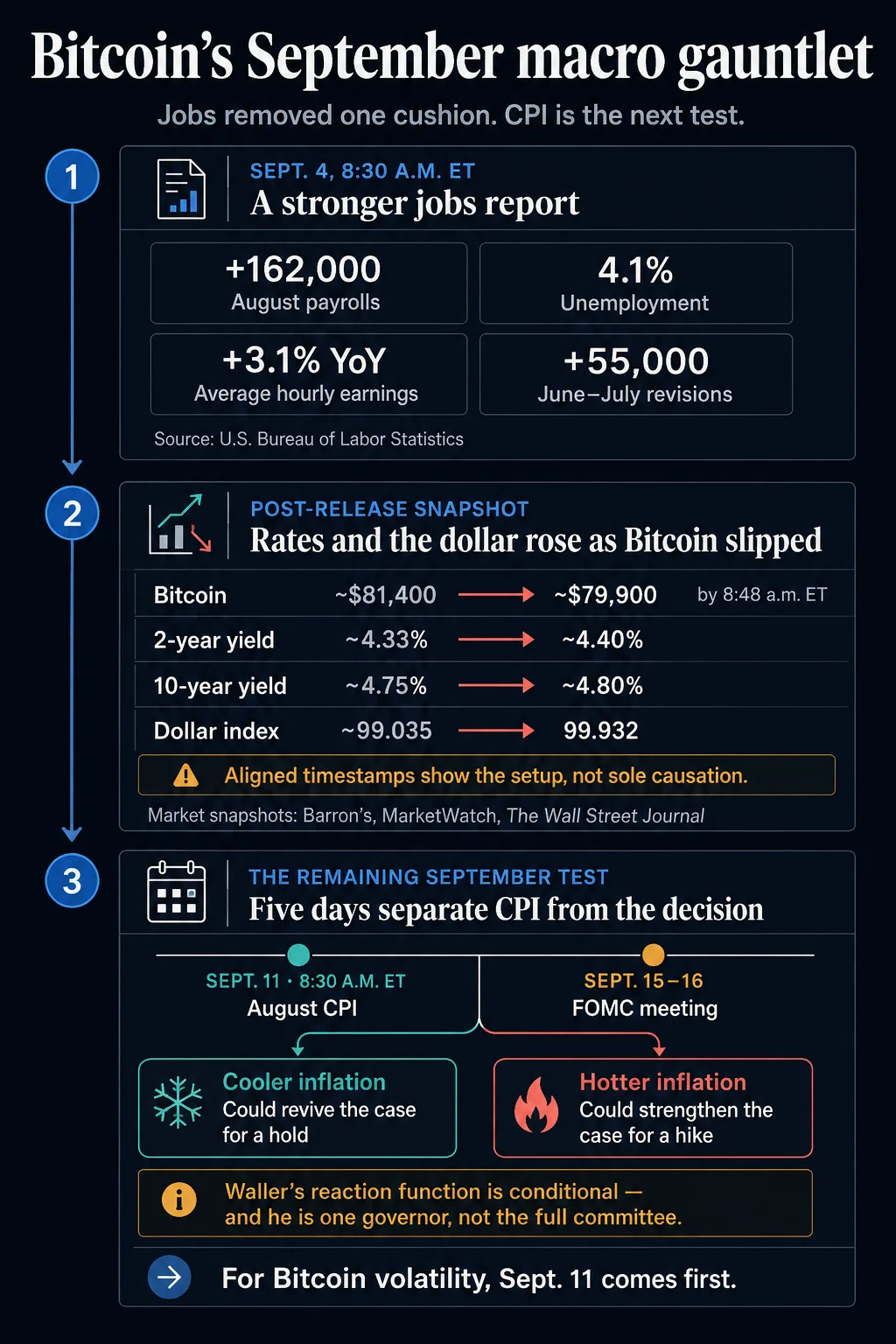
The momentum behind Bitcoin’s recent surge toward the $80,000 threshold encountered a significant macroeconomic obstacle on Sept. 4, following the release of a U.S. labor market report that defied cooling expectations. The August jobs data, which revealed hiring figures substantially higher than recent averages, effectively dismantled the "labor weakness" narrative that many investors hoped would force the Federal Reserve into a more accommodative monetary stance. As the labor market showed unexpected resilience, the policy cushion that had supported risk assets began to deflate, leading to an immediate repricing of expectations for the Federal Reserve’s September meeting.
Bitcoin, which had been testing the upper bounds of its current trading range, reacted swiftly to the news. The digital asset registered an intraday low of $78,660 shortly after the Bureau of Labor Statistics (BLS) release. Although it managed a modest recovery to trade near the $80,000 mark later in the session, the underlying financial conditions had shifted. The strengthening of the U.S. dollar and a spike in Treasury yields created a challenging environment for dollar-priced assets, signaling that the path to new all-time highs may be more arduous than previously anticipated.
A Detailed Breakdown of the August Payrolls Surge
The August employment report provided by the Bureau of Labor Statistics offered a stark contrast to the trend observed over the preceding year. Nonfarm payrolls increased by 162,000 for the month, a figure that represents more than five times the average monthly gain of 31,000 recorded over the previous 12 months. This surge suggests that despite high interest rates, the American economy continues to generate jobs at a pace that complicates the Federal Reserve’s mission to cool inflation.
Further bolstering the case for economic resilience were the revisions to previous months. The BLS adjusted June’s payroll growth upward to 31,000 and July’s growth to 21,000. Collectively, these revisions added 55,000 jobs to earlier estimates, indicating that the labor market was on a firmer footing throughout the summer than initial data had suggested. Meanwhile, the national unemployment rate remained stable at 4.1%, meeting analyst expectations but failing to provide the "softening" evidence that would have cleared the way for an immediate interest rate cut.
Wage growth also remained a point of focus for economists and market participants. Average hourly earnings for private nonfarm workers rose by 0.3% in August, bringing the average to $37.75. On a year-over-year basis, wages have increased by 3.1%. While this level of growth is generally seen as sustainable, it remains high enough to prevent the Federal Reserve from declaring a total victory over inflationary pressures, particularly in the services sector.
Sector-Specific Shifts and Economic Divergence
The composition of the August job gains revealed a bifurcated economy. The growth was heavily concentrated in specific industries, while others continued to contract. Food services and drinking places led the expansion, accounting for 59,000 new jobs. This was followed closely by local government education, which added 42,000 positions, a move likely influenced by seasonal hiring patterns as the new academic year approached.
Conversely, the information technology sector showed signs of continued stress, with employment falling by 23,000. This contraction reflects a broader trend of "right-sizing" within the tech industry as companies pivot toward automation and AI while grappling with the higher cost of capital. The healthcare sector, typically a reliable engine of growth, added only 13,000 jobs in August—significantly lower than its 32,000 average monthly gain over the prior year.
This uneven distribution of growth suggests that while the headline number is strong, the economy is not "overheating" in every corner. However, for the Federal Reserve, the aggregate strength of the labor market remains the primary metric for assessing the risk of a wage-price spiral. With the labor market holding steady, the central bank now has the luxury—or the burden—of focusing almost exclusively on the Consumer Price Index (CPI) to determine its next move.
Market Reactions: Yields, the Dollar, and the Bitcoin Correlation
The immediate aftermath of the jobs report saw a sharp realignment in the fixed-income and currency markets. According to data reported by MarketWatch, the two-year Treasury yield—which is highly sensitive to Federal Reserve policy expectations—climbed to approximately 4.40%, up from 4.33% prior to the release. The 10-year Treasury yield also moved higher, touching 4.80% compared to its pre-data level of just under 4.75%.
Simultaneously, the U.S. dollar gained strength against a basket of major currencies. The Wall Street Journal noted that the U.S. Dollar Index (DXY) touched 99.932, a significant jump from the 99.035 level observed before the payroll figures were made public. For Bitcoin, which is priced in dollars and often acts as an inverse proxy for dollar strength, this move represented a direct headwind.
Higher yields increase the opportunity cost of holding non-yielding assets like Bitcoin. When investors can earn a guaranteed 4.4% or 4.8% on government-backed debt, the relative attractiveness of high-volatility risk assets diminishes. The "tighter financial backdrop" mentioned by analysts refers to this exact phenomenon: a stronger dollar and higher yields drain liquidity from the system, making it more difficult for Bitcoin to sustain a breakout above major psychological resistance levels like $80,000.

The Federal Reserve’s Reaction Function and Governor Waller’s Stance
The implications of the jobs report were perhaps best framed by Federal Reserve Governor Christopher Waller. In a speech delivered just 24 hours before the BLS release, Waller laid out a clear "reaction function" for the Federal Open Market Committee (FOMC). He described the labor market as "satisfactory and stable," suggesting that employment was currently near its maximum sustainable level.
Waller’s remarks indicated that as long as the labor market remained robust, the Fed’s primary trigger for a policy shift would be inflation data. He noted that continued progress toward the 2% inflation goal would make him comfortable holding the policy rate steady. However, he warned that a "hot" inflation reading or evidence that progress had stalled could force the committee to consider another rate hike.
By removing the immediate threat of a labor market collapse, the August payroll report has simplified the Fed’s decision-making process for the September 15-16 meeting. Policymakers no longer need to worry about a "emergency" cut to save jobs; they can now wait for the inflation data to confirm whether their current restrictive stance is sufficient to bring prices under control.
Chronology of Key Events and Market Milestones
To understand the current volatility in the crypto markets, it is essential to look at the sequence of events that have shaped the month of September:
- September 3: Fed Governor Christopher Waller delivers a speech emphasizing that the labor market is stable, shifting the market’s focus entirely to upcoming inflation data.
- September 4 (8:30 a.m. ET): The BLS releases the August jobs report showing 162,000 new jobs, far exceeding the 31,000 average.
- September 4 (Post-release): Bitcoin drops to $78,660 as Treasury yields and the DXY spike. The asset later stabilizes near $80,000 but remains under pressure.
- September 11 (8:30 a.m. ET): Scheduled release of the August Consumer Price Index (CPI). This is widely considered the "final hurdle" for Bitcoin before the Fed’s decision.
- September 15-16: The Federal Open Market Committee (FOMC) meets to decide on interest rates. The decision will be announced on the afternoon of Sept. 16.
This timeline highlights that while the jobs report was a major event, it was only the first half of a two-part macro test for Bitcoin and the broader financial markets.
The September 11 CPI Deadline: Bitcoin’s Next Major Test
With the labor side of the Fed’s dual mandate currently appearing secure, the focus now shifts entirely to the Consumer Price Index (CPI) report scheduled for Sept. 11. For Bitcoin traders, this date represents the next major window for volatility. The five-day gap between the CPI report and the FOMC meeting means that the market will have nearly a week to price in the likely outcome of the Fed’s deliberations.
A "cool" CPI report—one that shows inflation continuing to trend toward the 2% target—would likely revive the narrative of a policy hold or an eventual pivot. This could alleviate the pressure from high Treasury yields and allow Bitcoin to reclaim its bullish momentum above $80,000. In this scenario, the market would view the strong labor data as a sign of a "soft landing," where the economy remains strong while inflation fades.
Conversely, a "hot" CPI report would be a worst-case scenario for risk assets. If inflation proves to be sticky or accelerating at the same time the labor market is showing resilience, the Federal Reserve may feel compelled to maintain higher rates for longer, or even consider a final "insurance" hike. Such a development would likely send Bitcoin toward lower support levels as the dollar continues to firm.
Broader Implications for the Crypto Ecosystem
The recent macro developments have broader implications for the cryptocurrency ecosystem beyond just Bitcoin’s price. The institutionalization of Bitcoin, largely driven by the launch of spot ETFs earlier in the year, has tied the asset more closely to traditional financial (TradFi) cycles. Institutional investors treat Bitcoin as a "high-beta" version of the Nasdaq; when liquidity tightens and yields rise, these players are often the first to de-risk.
Furthermore, the strength of the labor market suggests that consumer spending may remain robust, which is generally positive for the economy but keeps the "higher for longer" interest rate environment intact. For the crypto industry, which thrives on cheap capital and high liquidity, a prolonged period of high rates could slow down venture capital funding and decentralized finance (DeFi) activity.
As the September 16 FOMC meeting approaches, Bitcoin remains at a crossroads. The asset has shown remarkable resilience by staying close to $80,000 despite the hawkish shift in expectations. However, the lack of a "labor cushion" means that there is no safety net if the inflation data surprises to the upside. The coming days will determine whether Bitcoin’s attempt to establish a new price floor above $80,000 is a genuine breakout or a temporary peak in a tightening financial landscape.