Nila Kartika Wati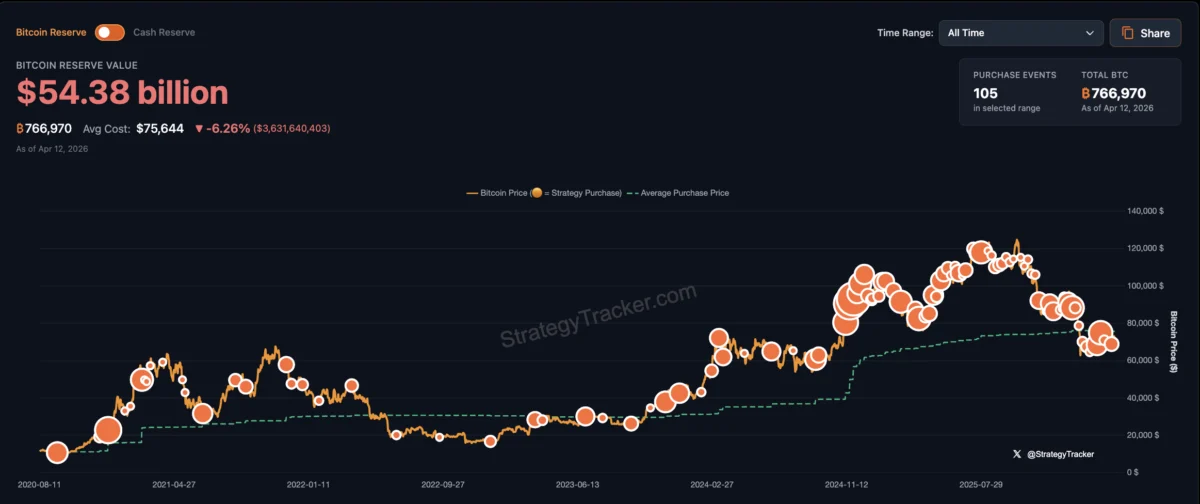
Tysons Corners, Virginia – Michael Saylor, the visionary co-founder and Executive Chairman of MicroStrategy, a prominent Bitcoin (BTC) treasury company, has once again signaled the firm’s unwavering commitment to its audacious Bitcoin acquisition strategy. His recent cryptic yet highly anticipated social media post, "Think bigger," on Sunday, accompanied by MicroStrategy’s characteristic chart of its BTC purchase history, served as an unmistakable harbinger of imminent Bitcoin buys, even as the cryptocurrency’s price retracted from its recent local high exceeding $73,000 earlier this week. This latest signal underscores MicroStrategy’s unique and often contrarian approach to corporate treasury management, a strategy that has seen the company amass a digital fortune unparalleled in the corporate world.
MicroStrategy’s steadfast accumulation has become a defining characteristic of its operational philosophy since its pivot to a Bitcoin-centric strategy. The company’s most recent disclosed Bitcoin acquisition occurred on April 6, when it added a substantial 4,871 coins to its reserves, investing over $329.8 million. This purchase propelled its total holdings to an astounding 766,970 BTC, valued at approximately $54.5 billion at the time of publication, according to the company’s own disclosures and public trackers like SaylorTracker.com. This relentless pursuit of Bitcoin has continued unabated, even through periods of significant market downturns, including bear markets that previously pushed Bitcoin’s price to two-year lows, at times placing MicroStrategy’s vast Bitcoin treasury underwater on paper.
MicroStrategy’s Unyielding Bitcoin Conviction Amid Market Flux
The current market environment presents a complex backdrop for MicroStrategy’s ongoing accumulation. While Bitcoin’s price recently surged past $73,000, setting new benchmarks, it has since experienced a notable pullback, aligning with broader market corrections and profit-taking activities across the cryptocurrency landscape. For long-term strategists like Saylor, such price fluctuations are viewed as transient market noise, offering strategic entry points rather than deterrents. Saylor’s "Think bigger" mantra encapsulates a philosophy that transcends short-term market volatility, emphasizing a long-horizon perspective on Bitcoin’s role as a global digital reserve asset and a foundational technology.
MicroStrategy’s transformative journey into Bitcoin began in August 2020, marking a monumental shift for the publicly traded business intelligence software firm. Under Saylor’s leadership, the company declared Bitcoin its primary treasury reserve asset, a decision that initially met with skepticism from traditional finance circles but has since garnered increasing attention and, to a lesser extent, imitation by several other corporations. This strategic pivot effectively transformed MicroStrategy into a de facto Bitcoin proxy, with its stock performance becoming increasingly correlated with Bitcoin’s price movements. The company has consistently leveraged various sophisticated financial mechanisms, including the issuance of convertible senior notes and common stock offerings, to fund its continuous Bitcoin purchases. This innovative approach to capital allocation within the corporate finance landscape has allowed MicroStrategy to scale its Bitcoin holdings without significantly diluting its core business operations or relying solely on internal cash flows.
Navigating Unrealized Losses: A Long-Term Perspective
Despite its impressive accumulation, MicroStrategy is currently navigating a period of significant unrealized losses on its Bitcoin holdings. According to a filing with the US Securities and Exchange Commission (SEC), the company reported a loss of nearly $14.5 billion on its BTC holdings for the first quarter of 2026. This substantial figure reflects the difference between the aggregate purchase price of its Bitcoin and its prevailing market value at the end of the reporting period. Critically, MicroStrategy’s current average cost of acquisition per BTC stands at $75,644, which is approximately $5,000 higher than the market price at the time of this writing.

It is crucial for investors and market observers to differentiate clearly between unrealized and realized losses. As long as MicroStrategy maintains its Bitcoin holdings and does not sell, these reported losses remain "on paper" and do not impact the company’s operational cash flow or immediate solvency. The company’s well-documented long-term "HODL" (hold on for dear life) strategy implies a profound belief that Bitcoin’s intrinsic value will appreciate significantly over extended periods, eventually surpassing their average acquisition cost and turning these current unrealized losses into substantial realized gains. This unwavering approach requires a high degree of conviction, strategic patience, and tolerance for market volatility, setting MicroStrategy apart from traditional corporate treasury management practices that typically prioritize liquidity, capital preservation, and minimal risk exposure to volatile assets. Saylor has frequently articulated that Bitcoin represents a superior inflation hedge and a more robust store of value compared to fiat currencies or other conventional financial assets, consistently justifying the company’s aggressive, debt-funded accumulation strategy.
The Looming Supply Squeeze: MicroStrategy’s Impact on Bitcoin Dynamics
MicroStrategy’s aggressive accumulation strategy is not merely an internal corporate finance decision; it has profound implications for the broader Bitcoin market, particularly concerning its fundamental supply-demand dynamics. The company has been acquiring Bitcoin at an astonishing rate, consistently far outstripping the pace at which new coins are introduced into circulation by miners. In March alone, MicroStrategy accumulated 46,233 BTC, a figure that is nearly three times the total newly mined supply of approximately 16,200 BTC during the same period. This trend, if sustained, highlights a significant imbalance in the market.
This persistent disparity between demand and new supply fuels the narrative of a potential "Bitcoin supply squeeze." With large institutional entities like MicroStrategy, and increasingly, spot Bitcoin Exchange-Traded Funds (ETFs) in the United States, absorbing a significant portion of both newly minted Bitcoin and existing circulating supply, the readily available supply for other buyers diminishes. The Bitcoin halving event, a programmed mechanism that periodically reduces the reward miners receive for validating transactions and adding new blocks to the blockchain, further exacerbates this supply constraint. Although the specific halving relevant to the article’s 2026 timeline is not explicitly detailed, its principle of drastically reducing new supply output strengthens the long-term supply squeeze argument. Analysts suggest that if demand, driven by corporate treasuries and the expanding universe of institutional investment vehicles, continues to outpace the constrained supply, it could lead to significant upward pressure on Bitcoin’s price.
Saylor’s perspective on Bitcoin market cycles has also undergone a notable evolution, as evidenced by his April statement: "The global consensus is that BTC is digital capital. The four-year cycle is dead. Price is now driven by capital flows. Bank and digital credit will determine Bitcoin’s growth trajectory." This reflects a growing conviction that the traditional four-year halving-driven price cycles, often associated with retail investor behavior and speculative trading, are gradually giving way to a new paradigm dominated by large-scale capital flows from institutional players and the integration of digital assets into traditional financial systems. This shift implies a more mature market, where Bitcoin’s price movements are increasingly influenced by macroeconomic factors, global liquidity conditions, and the seamless integration of digital assets into established financial infrastructure, rather than purely by the supply shock of a halving event.
A Contrasting Corporate Landscape: MicroStrategy vs. MARA Holdings
MicroStrategy’s singular, unwavering focus on Bitcoin accumulation stands in stark contrast to the strategies adopted by other companies in the broader digital asset space, particularly during the challenging market conditions referenced in the original article. While MicroStrategy consistently doubles down on its conviction, some Bitcoin treasury companies have shown "signs of capitulation" or strategic diversification amid a dynamic business environment.
A prime example is MARA Holdings (formerly Marathon Digital Holdings), a prominent Bitcoin mining company. In a significant strategic move, MARA Holdings sold 15,133 Bitcoin in March for roughly $1.1 billion. This substantial sale was not merely for short-term profit-taking but was strategically utilized to repurchase $1.0 billion of zero-coupon convertible notes at a discount. Chairman and CEO Fred Thiel commented that this transaction significantly enhanced the company’s "financial flexibility" and increased its "strategic optionality" as MARA simultaneously announced ambitious plans to expand "beyond pure-play Bitcoin mining into digital energy and AI/HPC infrastructure." This pivot reflects a broader industry trend where mining companies are exploring opportunities to leverage their energy infrastructure and computing power for diversified revenue streams beyond just Bitcoin production.

This divergence highlights two distinct, yet equally valid, philosophies within the corporate embrace of Bitcoin. MicroStrategy unequivocally represents the maximalist "Bitcoin-only" approach, viewing the cryptocurrency as the ultimate long-term treasury asset and betting its corporate future heavily on its appreciation and widespread adoption. MARA, on the other hand, exemplifies a more diversified and adaptive strategy, leveraging its Bitcoin holdings as a liquid financial instrument to reallocate capital and fund strategic pivots towards emerging technological sectors like Artificial Intelligence (AI) and High-Performance Computing (HPC) infrastructure, which are increasingly seen as synergistic with its energy-intensive mining operations. This indicates a nuanced and evolving understanding among corporate players regarding the multifaceted role of Bitcoin within their broader business models, with some viewing it as a core, irreplaceable asset and others as a valuable, albeit liquid, financial instrument to fund other strategic initiatives.
MicroStrategy’s sheer scale of Bitcoin holdings unequivocally dwarfs that of its corporate peers. With 766,970 BTC in reserve, it remains the undisputed leader among publicly traded companies by Bitcoin treasury holdings, according to industry trackers like BitcoinTreasuries.net. To put this into further perspective, the next largest corporate holder mentioned is Twenty One Capital, with a comparatively modest 43,514 BTC. This substantial lead underscores MicroStrategy’s unique position, the unparalleled magnitude of its commitment to the Bitcoin ecosystem, and the profound impact its strategy could have on the global adoption curve.
The Saylor Legacy and Broader Implications
Michael Saylor’s influence on the corporate adoption of Bitcoin cannot be overstated. His unwavering advocacy, often delivered with evangelical zeal, and MicroStrategy’s aggressive, consistent strategy have served as a powerful, real-world case study, demonstrating that a public company can successfully integrate Bitcoin into its treasury strategy, albeit with significant inherent volatility. Saylor’s vision extends far beyond mere investment; he fundamentally sees Bitcoin as a foundational technology reshaping global finance, a paradigm shift akin to the advent of the internet itself. His public statements and extensive interviews consistently reflect a deep understanding of Bitcoin’s technical, economic, and philosophical properties, positioning it as a fundamental shift in how value is stored, transferred, and governed in the 21st century.
The implications of MicroStrategy’s continued, aggressive accumulation are multifaceted and far-reaching. For Bitcoin maximalists and staunch believers, it serves as a powerful validation of the asset’s long-term value proposition and provides a consistent bullish signal to the broader market. For institutional investors who are still cautiously exploring the digital asset space, MicroStrategy’s strategy offers a benchmark, albeit an extreme one, for considering Bitcoin as a legitimate, albeit volatile, treasury asset. For the broader traditional financial market, it highlights the accelerating convergence of conventional finance with the burgeoning digital asset space, signaling a future where cryptocurrencies play an increasingly integrated role.
However, MicroStrategy’s highly concentrated strategy is not without its inherent risks. The significant leverage taken on through convertible notes exposes the company to interest rate fluctuations, refinancing risks, and potential pressure if Bitcoin’s price were to experience a prolonged and severe downturn, particularly below its average acquisition cost. Regulatory scrutiny, while seemingly less impactful in the current environment compared to earlier years, remains a background consideration for any public company with substantial digital asset exposure. Yet, MicroStrategy has successfully navigated these challenges thus far, cementing its status as a pioneering entity in corporate Bitcoin adoption.
As Bitcoin continues its journey towards broader institutional acceptance, fueled by the success of spot ETFs in major markets and increasing regulatory clarity in various jurisdictions worldwide, the role of companies like MicroStrategy becomes even more significant. They serve as crucial bellwethers, demonstrating both the immense potential and the inherent challenges of integrating this revolutionary digital asset into established financial frameworks. Michael Saylor’s latest signal, "Think bigger," is more than just a company announcement; it is a profound reaffirmation of an unwavering belief in Bitcoin’s future and a powerful directive for the market to consider the long-term, transformative power of digital capital. The ongoing saga of MicroStrategy’s Bitcoin treasury will undoubtedly continue to be a focal point for investors, analysts, and enthusiasts alike, offering crucial insights into the evolving landscape of global finance and corporate strategy.