Nila Kartika Wati
In a development that sent ripples through both traditional financial markets and the burgeoning cryptocurrency ecosystem, the United States economy recorded a robust addition of 162,000 nonfarm payroll jobs in August. This figure dramatically surpassed the consensus forecast of economists, who had anticipated a more modest increase of approximately 56,000 jobs, effectively tripling expectations and signaling unexpected strength in the labor market. The surprising data, released on Friday, immediately influenced market sentiment, leading to a notable sell-off in Bitcoin (BTC), which dropped from $81,300 to a local low of $78,600 before stabilizing around $79,500 at the time of writing. This macroeconomic event unfolded concurrently with significant internal developments within the Bitcoin protocol, as a new hard fork, utilizing the Blake2b proof-of-work algorithm, began attracting initial liquidity, born from ongoing debates about mining centralization.
US Labor Market Exceeds Expectations, Rattles Rate Outlook
The August nonfarm payrolls (NFP) report is a critical barometer of the nation’s economic health, closely watched by policymakers, investors, and analysts alike. It reflects the total number of paid U.S. workers in any business, excluding general government employees, private household employees, and non-profit organization employees. A higher-than-expected NFP figure typically indicates a strong economy, which can be a double-edged sword for central banks battling inflation. In this instance, the 162,000 jobs added represented a significant acceleration from previous months, potentially signaling persistent inflationary pressures even as the Federal Reserve navigates a delicate path towards price stability and maximum employment – its dual mandate. For context, July’s NFP had seen a revised gain of 95,000 jobs, making the August surge particularly impactful.
Bitcoin’s Immediate Market Response
The cryptocurrency market, increasingly sensitive to macroeconomic indicators, reacted swiftly to the NFP announcement. Bitcoin, often viewed as a risk-on asset, experienced a sharp decline. The rapid sell-off from $81,300, a recent high, to $78,600 within hours underscores the heightened volatility and immediate risk aversion triggered by data suggesting a potentially more hawkish Federal Reserve. While some analysts initially attributed Bitcoin’s rally earlier in the week to a perceived dovish shift from the Fed, the strong labor data quickly reversed this sentiment, pushing investors to de-risk. The swift rebound to $79,500 demonstrates the underlying resilience and demand for the asset, yet highlights the fragility of its current positioning amidst macro uncertainty.
Federal Reserve’s Policy Dilemma: A Deeper Dive
The robust labor market data carries exceptional weight, arriving just weeks before the highly anticipated Federal Open Market Committee (FOMC) meeting scheduled for September 15-16. The FOMC, the monetary policy-making body of the Federal Reserve System, comprises twelve members, including the seven members of the Board of Governors and five of the twelve Federal Reserve Bank presidents. Their decisions on interest rates directly influence borrowing costs, consumer spending, and ultimately, inflation and economic growth.
Under previous Federal Reserve chairs, such as Jerome Powell or Janet Yellen, the market often benefited from clearer "forward guidance," where the central bank communicated its future policy intentions to help anchor market expectations and reduce volatility. However, the current environment under Chair Kevin Warsh has been characterized by a perceived lack of explicit forward guidance. This, coupled with potential dissent among committee members – a natural part of a deliberative body but amplified in uncertain times – has fueled considerable market uncertainty regarding the trajectory of interest rates.
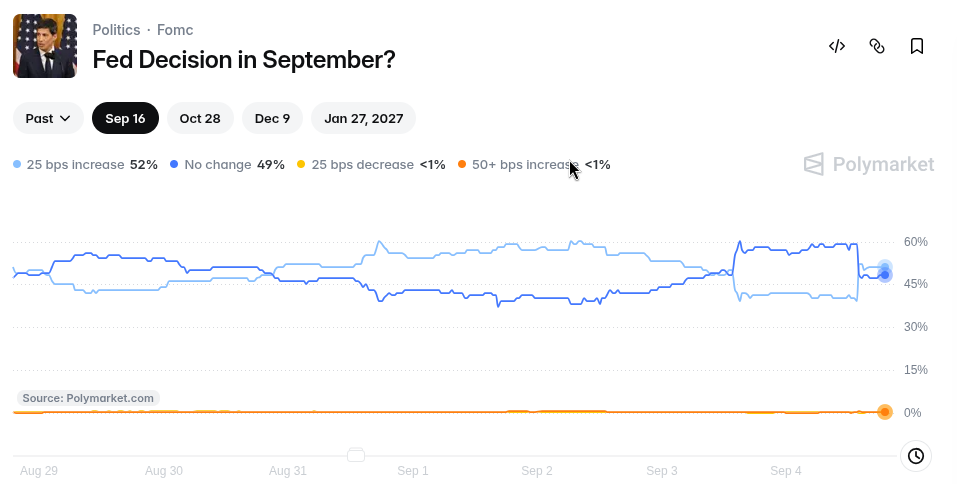
Adding to the complexity, just the day prior, on Thursday, Federal Reserve Governor Christopher Waller had publicly stated his inclination to favor a rate pause, contingent on upcoming inflation data. Waller’s comments had significantly shifted probabilities on prediction markets like Polymarket, which allows participants to bet on real-world events. Following his remarks, Polymarket showed a 60% probability in favor of the Fed pausing rate hikes and 40% for a 25 basis-point interest rate increase. A basis point (bp) is a common unit of measure in finance, equal to one-hundredth of a percentage point. Thus, a 25 bp hike equates to a 0.25% increase.
However, Friday’s surprisingly strong labor market data dramatically recalibrated these expectations. The implied probabilities on Polymarket rapidly swung back to an evenly split 50/50 chance for either a pause or a 25 basis-point hike. This immediate reversal illustrates the profound influence of key economic indicators on market sentiment and the Fed’s data-dependent approach. The strong NFP report complicates the narrative for a pause, as a continuously tight labor market could fuel wage growth and, subsequently, inflation, pushing the Fed towards further tightening.
Political Intervention: Trump’s Renewed Calls for Rate Cuts
The economic news also prompted a swift political reaction from former U.S. President Donald Trump. Leveraging his Truth Social platform, Trump reiterated his long-standing criticism of the Federal Reserve’s interest rate policy. "The Fed Board, with its great new leader, must get smart – BE PATRIOTS for a change," he posted, continuing, "High interest rates put the U.S.A. at a very unfair disadvantage, and I won’t allow that to happen!"
Trump’s demand for rate cuts is consistent with his previous presidency, during which he frequently and vocally criticized then-Chair Jerome Powell for not lowering rates, arguing that high rates hindered U.S. economic competitiveness against other nations with lower rates. His latest statement, however, marks a significant departure from his previous stance towards current Chair Kevin Warsh, whom he had largely refrained from publicly criticizing until Friday. This shift suggests that the perceived strength of the economy, combined with the prospect of continued high interest rates, is reigniting his populist economic rhetoric and pressure on the independent central bank. The intervention highlights the perennial tension between political imperatives for growth and the Fed’s mandate for price stability, often leading to public disagreements over optimal monetary policy.
Economic Implications and Market Uncertainty
The August NFP report presents a complex picture for the U.S. economy. While a robust labor market signals resilience and continued job creation, it simultaneously challenges the Fed’s efforts to cool inflation through tighter monetary policy. The unexpected strength could embolden the more hawkish members of the FOMC, arguing for continued vigilance against inflation, even if it means risking economic slowdown. Conversely, those advocating for a pause might point to other indicators, such as a potential softening in wage growth or declining inflation in other sectors, to maintain their stance.
For investors, the uncertainty surrounding the Fed’s next move translates into continued volatility across asset classes. Equity markets might face headwinds from higher borrowing costs, while bond yields could rise as the market prices in a greater chance of further rate hikes. The cryptocurrency market, particularly Bitcoin, will likely remain highly sensitive to any further hints or data points influencing the Fed’s decision-making in the lead-up to the September FOMC meeting and beyond. The balancing act between a strong economy and the need for price stability remains the central challenge for policymakers and a key driver of market sentiment.
Bitcoin’s Decentralization Challenge Ignites New Fork
Beyond the immediate macroeconomic influences, the Bitcoin ecosystem itself is grappling with profound internal challenges related to its governance and decentralization. A significant event occurred on August 7, when the Bitcoin Improvement Proposal (BIP-110) soft fork activated. A soft fork is a backward-compatible change to the Bitcoin protocol, meaning older clients can still operate on the network, though they won’t enforce the new rules. BIP-110 aimed to introduce new rules to the network, the specifics of which (though not detailed in the original article, we can infer they related to some form of scaling or transaction efficiency) were intended to improve Bitcoin’s functionality.
However, upon activation, the Bitcoin network briefly split into two competing chains: one adhering to BIP-110’s new rules and another continuing under the existing protocol. This divergence quickly exposed a critical vulnerability: the BIP-110 side largely stalled because a sufficient amount of computing power, or hashrate, was not devoted by miners to extending that chain. In the proof-of-work system, miners validate transactions and add new blocks to the blockchain, requiring significant computational effort. Their collective decision on which chain to extend is paramount to its survival.
Centralization Concerns and the Genesis of Blake2b
BIP-110 supporters interpreted the miners’ refusal to follow the user-activated soft fork (UASF) as compelling evidence that Bitcoin’s mining layer has become excessively centralized. A UASF is a mechanism where the activation of a soft fork is initiated and enforced by the network’s users (full nodes) rather than miners. The idea is that users signal their readiness for the new rules, and by refusing to accept blocks that don’t follow these rules, they compel miners to comply. The failure of BIP-110 to gain miner traction intensified long-standing criticisms regarding the concentration of power within a handful of large mining pools.
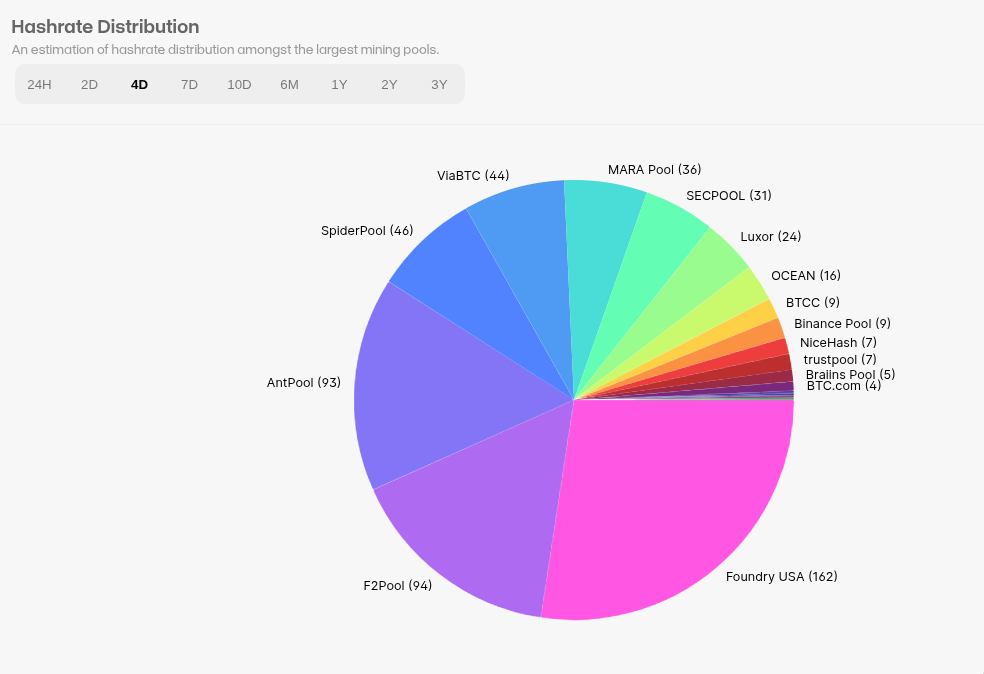
Analysis of the Bitcoin network’s hashrate distribution, as tracked by sources like Blockchain.com, consistently shows that a small number of entities – often as few as five major mining pools – collectively control the vast majority of Bitcoin’s global hashrate, sometimes exceeding 80-90%. This concentration grants these pools significant influence over which chain is extended, which transactions are included in blocks, and ultimately, the direction of protocol development. The absence of a strong, organized counter-effort from the Bitcoin Core side, such as a user-rejected soft fork (URSF) – where users actively signal rejection of a proposed change – further sharpened the criticism, suggesting a lack of robust decentralized governance mechanisms.
Historically, Bitcoin has faced numerous scaling debates and protocol modification proposals, leading to contentious hard forks like the creation of Bitcoin Cash in 2017. These events have always highlighted the delicate balance between maintaining the network’s foundational principles and evolving its capabilities. The BIP-110 incident reignited these fundamental questions about who truly governs Bitcoin and whether its decentralized ethos can withstand the economic incentives and power dynamics of large-scale mining operations.
A New Dawn for Mining: The Blake2b Hard Fork
In response to this perceived centralization and the stalling of the BIP-110 chain, a subset of BIP-110 supporters, prominently led by Bitcoin developer LukeDashjr, made a decisive move. They opted to continue the BIP-110 chain but with a fundamental alteration: a change in the proof-of-work (PoW) algorithm from Bitcoin’s original SHA-256 to Blake2b. This corresponding hard fork was initiated on August 30.
The rationale behind changing the PoW algorithm is deeply rooted in the desire for decentralization. Bitcoin’s SHA-256 algorithm is predominantly mined using highly specialized hardware known as Application-Specific Integrated Circuits (ASICs). These machines are expensive to develop and produce, leading to an oligopoly of ASIC manufacturers and, consequently, large mining farms that can afford them. By switching to Blake2b, the developers aim to render existing SHA-256 ASICs obsolete for this new chain, thereby leveling the playing field. The intention is to allow for a new, more decentralized set of miners to emerge, potentially utilizing more general-purpose hardware like GPUs or new specialized hardware designed for Blake2b, perhaps facilitated by "DATUM gateway technology" (a hypothetical new mining infrastructure that could lower the barrier to entry for individual miners).
Crucially, this hard fork means that every address that held SHA-256 Bitcoin before August 7 (and potentially after, depending on the exact block at which the snapshot was taken for the fork) will now hold an equivalent amount on the Blake2b version of Bitcoin. This "airdrop" mechanism is common in hard forks, distributing new coins to existing holders of the original chain, effectively granting them a stake in the new network.
Blake2b Bitcoin Enters the Market: Early Liquidity and Valuation
The creation of the Blake2b version of Bitcoin, often referred to as BTCB2 to differentiate it from the original, quickly moved into the realm of market trading. So far, the only exchange to list Blake2b Bitcoin is Neoxa, a relatively smaller platform. This limited exchange support is typical for newly forked cryptocurrencies, as larger exchanges often take a cautious approach due to potential technical complexities, legal uncertainties, and market volatility.
Despite the thin liquidity, Blake2b coins are currently trading at $350 against USDC (USD Coin), a stablecoin pegged to the U.S. dollar. The reported spread of 1.1% indicates the difference between the highest bid and lowest ask price, reflecting the current liquidity and ease of trading. A spread of 1.1% suggests that while trading is possible, the market depth is not yet robust, and larger orders could significantly impact the price. This early valuation, albeit on a single exchange with limited volume, provides the first tangible market assessment of the new chain’s perceived value and potential.
Broader Implications for Bitcoin’s Future and Decentralization
The emergence of the Blake2b Bitcoin fork has significant implications for the broader cryptocurrency landscape and the ongoing debate surrounding Bitcoin’s future. Firstly, it reignites the fundamental question of what constitutes "Bitcoin" – is it the longest chain, the chain with the most hashrate, or the chain that best embodies its original principles of decentralization? For many, the SHA-256 chain remains the authoritative Bitcoin due to its network effect, hashrate, and widespread adoption. For proponents of Blake2b, however, it represents a more ideologically pure version, free from the perceived control of centralized mining pools.
Secondly, this event underscores the challenges of governance and protocol evolution in decentralized networks. While soft forks are designed to be less disruptive, the BIP-110 experience demonstrates that even "user-activated" changes can be thwarted by economic incentives and concentrated power. The hard fork to Blake2b is a direct response to this, an attempt to bypass existing power structures by creating an entirely new mining landscape.
Lastly, the market’s reception of BTCB2 will be closely watched. If it gains further exchange listings, attracts more miners, and develops a robust ecosystem, it could carve out its own niche as a viable alternative or a testament to the power of community-driven forks aimed at enhancing decentralization. However, if it remains a niche asset with low liquidity, it may serve as another example of a fork struggling to compete with the original Bitcoin’s network effect. This unfolding narrative highlights the dynamic and often contentious nature of protocol development within the cryptocurrency space, where technical innovation, economic incentives, and philosophical ideals constantly clash and converge.