admin
admin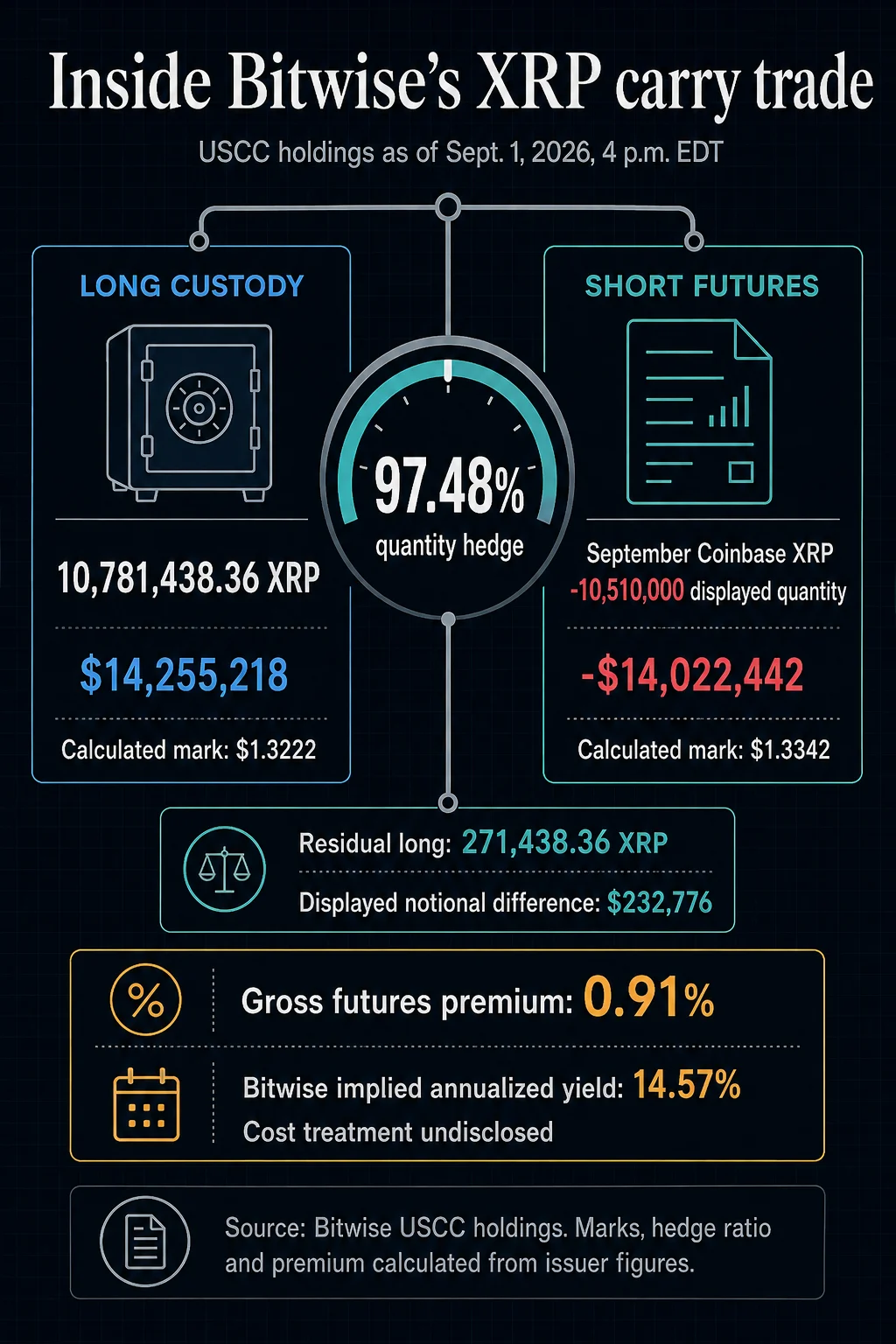
In a move that offers a rare glimpse into the sophisticated strategies employed by institutional investors in the cryptocurrency market, Bitwise Investments has publicly detailed its participation in an XRP carry trade. The Bitwise Crypto Carry Fund (USCC) executed a carefully constructed position involving XRP held in custody and a corresponding short position in Coinbase XRP futures, aiming to capture the premium generated by the difference between the spot price of XRP and its futures contracts. This disclosure provides valuable insights into how digital asset investment firms are leveraging market inefficiencies and managing risk within the volatile crypto landscape.
The core of Bitwise’s strategy, as revealed by its holdings table as of September 1st, 4 p.m. EDT, involved holding 10,781,438.36 XRP in custody. This spot position was almost perfectly hedged with a short position of 10,510,000 XRP in September Coinbase XRP futures. This near-market-neutral structure, with a quantity match of 97.48%, was designed to minimize exposure to the directional price movements of XRP while positioning the fund to profit from the convergence of futures and spot prices at settlement. The futures leg of this trade carried an implied yield of 14.57%, indicating the annualized return the fund aimed to achieve on this specific position.
This specific trade structure supports a clear conclusion: XRP was being utilized as inventory for a basis trade, a strategy that seeks to profit from discrepancies between the spot market and futures market for an asset. It is important to note that this position does not necessarily reflect broader institutional demand for XRP itself, including demand for Bitwise’s separate spot XRP product, the Bitwise XRP ETF. The USCC’s objective is to capitalize on futures premiums across various crypto assets, and this XRP trade represents one instance of that strategy in action.
Monetizing the Futures Premium: From Basis to Annualized Yield
The mechanics of this carry trade illustrate a sophisticated approach to generating returns. The strategy hinges on the basis – the difference between the futures price and the spot price. In this case, the near-perfect hedge of 97.48% was achieved by dividing the futures quantity (-10,510,000 XRP) by the custody quantity (10,781,438.36 XRP), resulting in a minimal residual long position of 271,438.36 XRP. The notional values of these positions differed by $232,776, highlighting the precise calibration of the trade.
The table below, derived from Bitwise’s disclosure, provides a clear breakdown of the XRP leg of the USCC:
| USCC XRP Leg | Displayed Quantity | Notional Value | Calculated Unit Mark |
|---|---|---|---|
| Custody | 10,781,438.36 | $14,255,218 | $1.3222 |
| September Coinbase Futures Short | -10,510,000 | -$14,022,442 | $1.3342 |
| Calculated Difference | 271,438.36 | $232,776 | Not Applicable |
The spread between the spot and futures price was approximately 0.91%. This was calculated by dividing each notional value by its displayed quantity, yielding a spot-equivalent mark of $1.3222 and a futures-equivalent mark of $1.3342. The futures contract was trading at a premium of roughly 1.2 cents, or 0.91%, above the spot price.
This premium is the engine of the cash-and-carry strategy. In essence, the fund buys the underlying asset (XRP in this instance) and simultaneously sells a futures contract that is trading at a higher price. The expectation is that as the futures contract approaches its settlement date, its price will converge with the spot price. This convergence locks in the premium earned, while the near-market-neutral positioning aims to offset the majority of the price risk associated with holding the underlying asset. Bitwise itself describes the USCC as a qualified-purchaser fund specifically designed to capitalize on these futures premiums over spot prices across the cryptocurrency markets.
The impressive 14.57% implied yield is a result of annualizing this short-term premium. Bitwise defines holding-level implied yield as an annualized figure assuming the position is held to maturity or otherwise not sold prior to settlement. Therefore, the 14.57% represents the potential yearly return if this specific premium were to persist and be captured on an ongoing basis. While the gross premium difference was 0.91%, the annualized rate highlights the power of compounding and the attraction of such arbitrage opportunities.
However, it is crucial to distinguish this implied yield from realized investor returns. Bitwise reports the fund’s 30-day yield separately and also discloses a 0.75% management fee. The exact calculation of the 14.57% figure involves complex accounting for execution costs, financing, custody fees, margin requirements, and potential "roll" costs if the futures contract needs to be replaced before settlement. Given these variables and the proprietary nature of Bitwise’s methodologies, the 14.57% should be understood as Bitwise’s annualized implied rate for the displayed futures holding, rather than a guaranteed investor return.
Even with a 97.48% hedge, residual risks remain inherent in such a strategy. Spot and futures prices can exhibit divergent movements leading up to settlement, creating temporary imbalances. The fund must also diligently manage its custody of the underlying asset and maintain sufficient margin for its short futures position. Furthermore, the cash-settlement benchmark for the futures contract might differ from the actual price at which the fund can liquidate its custody inventory. The remaining 271,438.36 XRP also exposes the fund to direct price fluctuations in XRP.

The public table, while providing clarity on the quantity comparison, leaves the exact number of futures contracts unresolved. Coinbase Derivatives filings indicate that its standard monthly XRP future contract (XRL) represents 10,000 XRP. However, Coinbase offers multiple XRP futures products, and Bitwise has not specified the exact product code used for this trade. Therefore, any conversion of the displayed futures quantity into a definitive number of contracts would be conditional on the specific product utilized.
CFTC Data Reveals a Bifurcated Futures Market Landscape
The economic foundation of a positive basis, such as the one observed in XRP futures, lies in the willingness of futures buyers to pay a premium over the prevailing spot price. Exchange clearinghouses facilitate this by transforming individual premiums into a market-wide relationship, which is then reflected in public reporting categorized by broad trader types.
The Commodity Futures Trading Commission’s (CFTC) "Traders in Financial Futures" report offers a valuable macro-level perspective on the XRP futures market. As of August 25th, standard Coinbase XRP futures exhibited an open interest of 20,518 contracts. This open interest was largely dominated by dealer and intermediary accounts, which collectively held 17,853 long contracts. Asset managers and institutional accounts accounted for an additional 1,800 long contracts.
This data reveals a notable split in market sentiment, particularly when considering leveraged funds. These entities, often associated with more speculative trading, were predominantly positioned on the short side of the market. They held 13,822 outright short contracts and no outright long positions within their category. Other reportable traders held 4,824 short contracts, while non-reportable traders accounted for 1,011 contracts.
This snapshot places leveraged funds on the opposite side of the prevailing narrative, aligning with the direction of Bitwise’s disclosed hedge. However, the aggregated CFTC figures do not reveal Bitwise’s specific identity as a counterparty, nor do they detail the precise positioning for September contracts, which predates the USCC holdings table by seven days. The CFTC data covers all listed maturities and provides a broader market view rather than granular details of specific fund trades.
A sharper contrast in institutional behavior emerges when examining Bitwise’s own product suite. The Bitwise XRP ETF, a separate investment vehicle, reported holding 361,995,068.31 XRP in its trust as of September 2nd, valued at approximately $531.3 million. This ETF’s filings with the Securities and Exchange Commission (SEC) clearly state its objective: to provide investors with exposure to the value of the XRP it holds, less expenses, with XRP being its sole asset. This signifies a direct, long-only exposure to XRP.
In contrast, the USCC’s strategy involved a paired spot-and-futures position, a sophisticated arbitrage play. The XRP ETF, on the other hand, holds XRP directly within a trust structure for straightforward spot exposure. These observable product designs from Bitwise showcase two fundamentally different approaches to the same underlying asset, catering to distinct investor objectives. The ETF’s prospectus and disclosures do not detail any specific hedging strategies employed by its investors.
Broader Implications and Market Dynamics
Bitwise’s disclosure of its 14.57% annualized implied yield on the XRP carry trade underscores the attractiveness of forward premiums in certain cryptocurrency markets at specific points in time. The detailed holdings table provides concrete evidence of a substantial carry trade, quantifying the minimal directional XRP exposure remaining after the implementation of a robust hedge.
The identities of the futures buyers who took the other side of Bitwise’s trades remain private, obscured within the broader market data. Furthermore, the overall institutional appetite for XRP – whether it is driven by directional bets on price appreciation or by arbitrage opportunities like the basis trade – remains an unresolved question beyond this specific named fund.
The existence of such carry trades is a sign of market maturation. As institutional players become more sophisticated, they seek out and exploit these inefficiencies, contributing to greater market liquidity and price discovery. The Bitwise XRP carry trade exemplifies how these entities can navigate the complexities of the crypto market, leveraging derivatives to generate returns while actively managing risk. This transparency, albeit rare, is crucial for building confidence and understanding within the institutional investment community. It allows observers to discern between direct asset speculation and more complex, hedged strategies aimed at capturing specific market premiums. The continued evolution of such strategies will undoubtedly shape the future landscape of institutional crypto investing.