admin
admin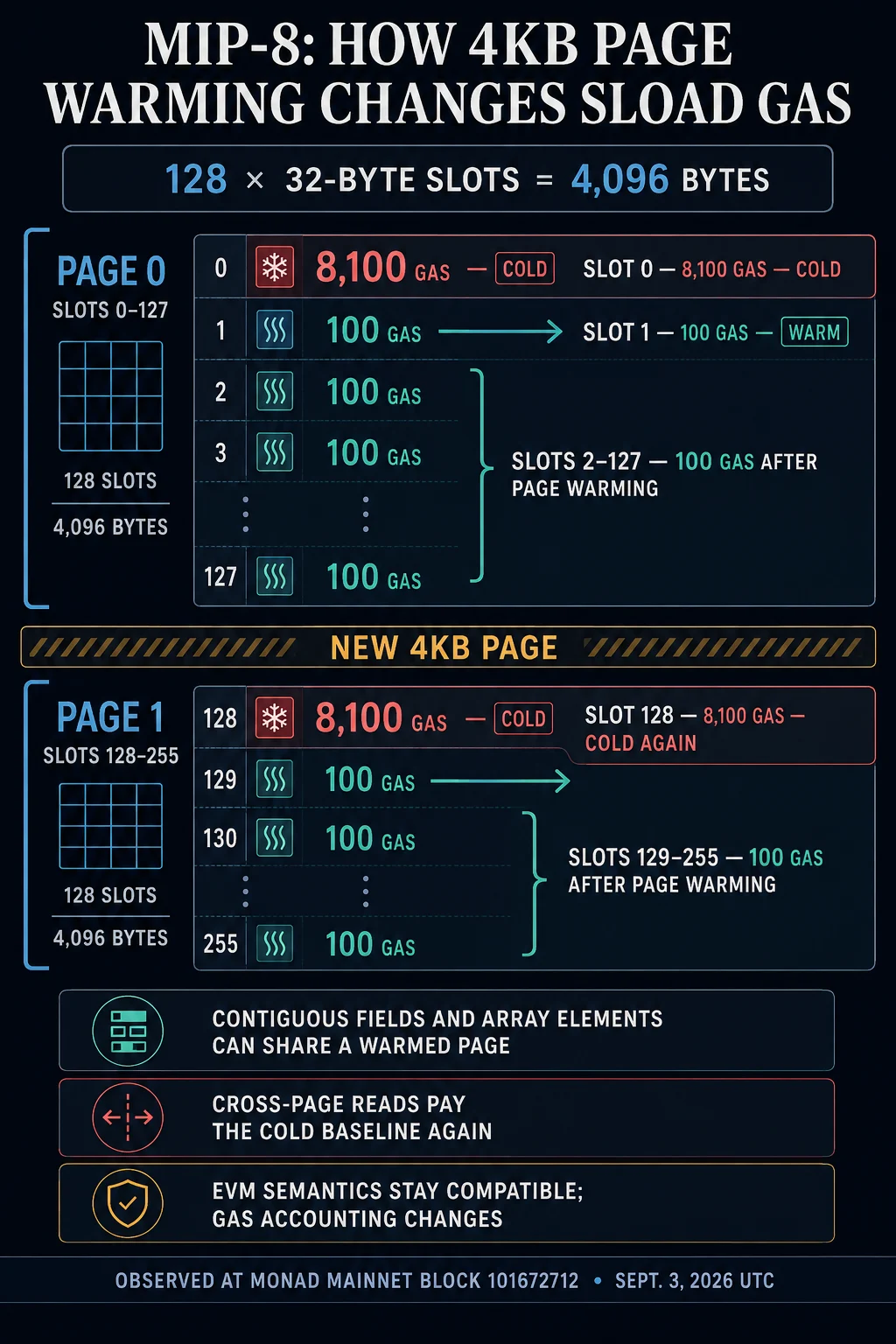
Monad, a prominent player in the Ethereum Virtual Machine (EVM)-compatible blockchain space, has successfully implemented a significant network upgrade, MonadTen, on its mainnet. Activated precisely at 14:30 UTC on September 2nd, this pivotal change, known as MIP-8, fundamentally alters how smart contracts incur costs for reading data from storage. The upgrade replaces the previous method of "slot-by-slot warming" with a more efficient approach that groups 128 consecutive storage slots into a single "page," drastically reducing associated gas fees.
This groundbreaking adjustment, detailed in the MonadTen release notes and confirmed by the activation at Unix timestamp 1788359400, signifies a major step forward in optimizing blockchain transaction costs, particularly for data-intensive operations. Under the previous MonadNine protocol, each individual read of a storage slot incurred a substantial gas fee. However, the new MIP-8 specification introduces a tiered pricing model that rewards data locality. The initial read from any storage slot within a newly accessed page carries a cost of 8,100 gas. Crucially, any subsequent reads from other slots within that same warmed page, for the duration of the ongoing transaction, are reduced to a mere 100 gas. This represents an astonishing potential reduction of up to 98.7% for data reads within a warmed page, a figure that could profoundly impact the economics of decentralized applications (dApps) built on Monad.
The implications of this change are far-reaching, especially for smart contracts that frequently access their internal state. Previously, even adjacent storage slots would be treated as independent entities, each incurring the full "cold" read cost of 8,100 gas if they hadn’t been accessed recently. Now, thanks to the page-warming mechanism, a contract that reads multiple pieces of data stored contiguously will benefit immensely. For instance, reading slot 0 might cost 8,100 gas, but if slot 1 is also on the same page and accessed within the same transaction, it will only cost an additional 100 gas. This efficiency is directly tied to the physical arrangement of data on the blockchain.
Understanding the Storage Page Model
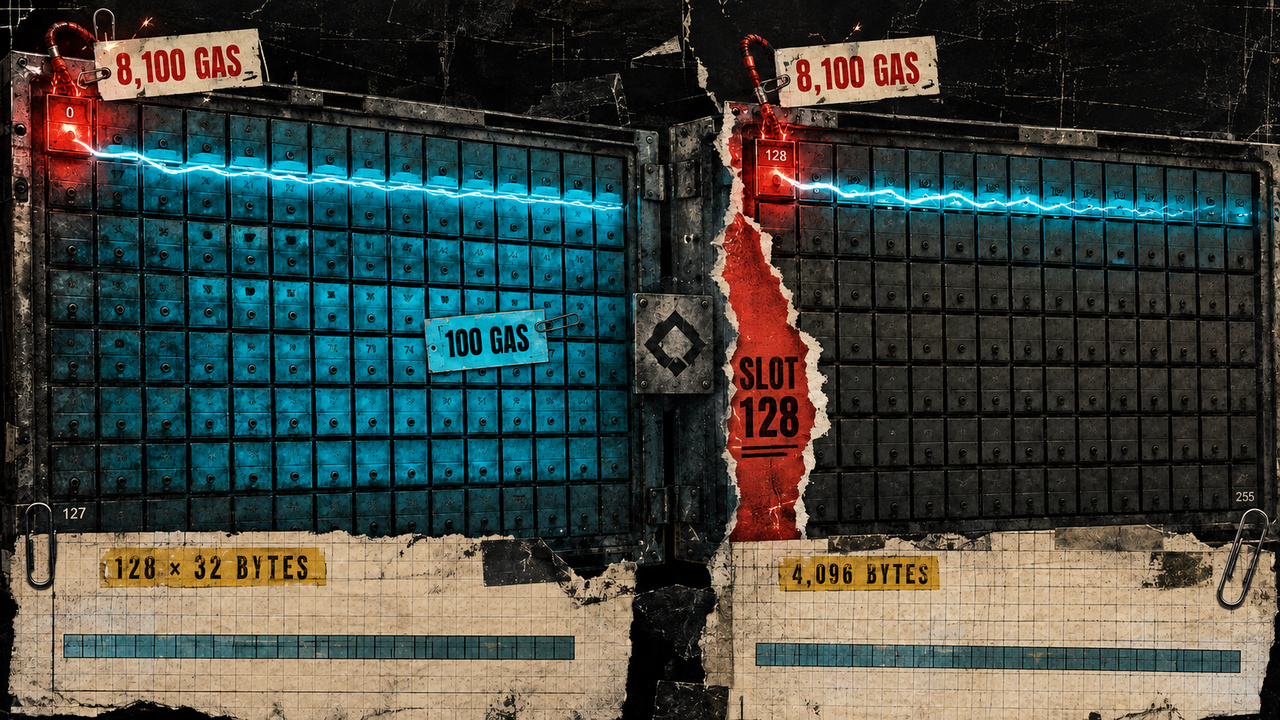
The core of MIP-8 lies in its redefinition of how storage is accessed and billed. A "storage page" within Monad is defined as a contiguous block of 128 words, with each word being 32 bytes. This equates to a 4,096-byte (4KB) chunk of storage. The initial access to any data within such a page triggers the higher gas fee, effectively "warming" that entire page for the current transaction. Subsequent operations that read data from any slot within this now-warmed page will then benefit from the significantly lower 100 gas fee. It’s important to note that this warmed state is transactional; if a smart contract call or transaction reverts, the page may revert to its "cold" state for subsequent operations.
This new pricing structure is vividly illustrated by the gas costs observed on Monad’s mainnet. A recent block measurement on mainnet block 101672712 confirmed these figures: reading slot 0 cost 8,100 gas, while reading slot 1 on the same page dropped to 100 gas. However, upon reaching slot 128, which marks the beginning of the next storage page, the cost reverted to 8,100 gas, underscoring the page-boundary mechanism.
Impact on Developer Practices and Data Structures
The MIP-8 upgrade introduces a strong economic incentive for developers to optimize their smart contract storage layouts. Data that is naturally clustered together, such as sequential state variables, fields within a struct, or elements of an array, will now benefit from the page-warming discount. This encourages more efficient data organization, potentially leading to substantial cost savings for users interacting with these contracts.
For example, consider a typical Solidity contract managing user profiles. If each user’s data (e.g., name, email, balance) is stored in consecutive slots, reading a full profile would trigger the initial 8,100 gas for the first piece of data, and then significantly cheaper reads for the subsequent profile attributes as they reside within the same warmed page. This contrasts with a scenario where data might be scattered across different storage locations, requiring multiple "cold" reads.
However, the benefit is not universal across all data structures. Mappings, which often resolve to dispersed storage locations based on a computed hash of the key, may not automatically benefit from page-warming for the mapping’s fundamental access. Nevertheless, if a struct is stored as the value within such a mapping, the individual fields of that struct, being contiguous, can still leverage the page-warming discount once the mapping’s value has been accessed and warmed.
The architecture of Monad’s storage system means that certain data access patterns will still incur the higher costs. Hashed storage, or data that is deliberately unaligned, will continue to interact with the blockchain’s "cold" storage baseline. Likewise, any read operation that crosses a page boundary—meaning it starts on one 128-slot page and ends on another—will incur the 8,100 gas fee for accessing the data on the new page. The overall savings achieved by MIP-8 are thus directly correlated with the degree to which a transaction’s data accesses remain clustered within single storage pages.
Technical Underpinnings and Compatibility Considerations
MIP-8 is designed to maintain EVM execution semantics while subtly altering the underlying assumptions used by various blockchain tools. This includes systems that generate access lists, construct storage proofs, or perform gas estimations. The upgrade means that EIP-2930 access list entries, which specify which storage slots a transaction intends to access, will now implicitly warm entire pages. Consequently, the formats used for generating and verifying proofs must be updated to accurately reflect this new page-based storage model.
The Monad team has identified contracts that might hardcode storage opcode gas costs as a primary area of potential compatibility risk. Developers who have built applications or tooling that directly embeds assumptions about gas costs for individual storage reads may need to review and update their code to align with the new page-warming economics. The Monad team has provided comprehensive documentation, including the final MIP-8 specification and updated opcode pricing guides, to assist developers in navigating this transition.

The MonadTen release record clearly delineates the transition from MonadNine to MonadTen rules, emphasizing the exact moment of activation at Unix timestamp 1788359400. This precise chronological marker ensures a clean and auditable upgrade process.
Broader Implications for the Blockchain Ecosystem
The successful implementation of MIP-8 by Monad is a significant development for the scalability and cost-efficiency of EVM-compatible blockchains. By incentivizing efficient data storage and access patterns, Monad is paving the way for more complex and resource-intensive dApps to operate economically. This could attract a new wave of developers and applications that might have previously found the gas costs associated with extensive data manipulation on other chains prohibitive.
The reduction in storage read costs directly translates to lower transaction fees for end-users, making the Monad network more accessible and competitive. For DeFi protocols, NFT marketplaces, gaming applications, and other dApps that rely heavily on on-chain data storage and retrieval, this upgrade offers a tangible benefit that can be passed on to their user base.
Furthermore, the innovation demonstrated by MIP-8 highlights Monad’s commitment to pushing the boundaries of blockchain performance. The concept of "page warming" is a novel approach to gas optimization that could potentially inspire similar innovations in other blockchain networks. As the blockchain space continues to mature, advancements in storage efficiency and cost reduction are paramount for mainstream adoption. Monad’s proactive approach with MIP-8 positions it as a leader in this critical area of development.
The observed reduction from 8,100 gas to 100 gas for subsequent reads within a warmed page represents an efficiency gain of 98.7%. This dramatic improvement underscores the economic rationale behind the new storage model. Developers are now strongly encouraged to structure their smart contract data in a manner that maximizes these contiguous reads, leading to a more efficient and cost-effective blockchain experience for all participants.
In essence, Monad’s MIP-8 upgrade is not just a technical adjustment; it’s an economic re-engineering of data access on the blockchain. By aligning gas costs with the physical proximity of data, Monad is fostering a more efficient, scalable, and developer-friendly ecosystem, setting a new benchmark for cost optimization in the EVM-compatible blockchain landscape. The focus on grouping data into pages and rewarding locality is a testament to Monad’s strategic vision for future-proofing its network against the increasing demands of decentralized applications.