James Watt
The landscape of Ethereum staking, a cornerstone of the network’s Proof-of-Stake (PoS) consensus, is continually evolving to address the complexities and inefficiencies inherent in its design. A significant hurdle for both individual and institutional stakers has been the lengthy validator entry and exit queues, which can stretch for over 50 days, leading to substantial periods where staked ETH remains unproductive and potential rewards are forgone. This challenge is particularly acute for operators looking to migrate existing stake to more advanced liquid staking solutions such as stVaults, which offer enhanced liquidity and seamless integration with the broader decentralized finance (DeFi) ecosystem. The traditional method of migration — exiting an existing validator and then re-depositing ETH into a new stVaults validator — subjects the entire staked amount to both the exit and entry queues, resulting in considerable opportunity costs.
Background: The Evolution of Ethereum Staking and Its Challenges
Ethereum’s monumental shift from Proof-of-Work (PoW) to Proof-of-Stake with "The Merge" in September 2022 ushered in a new era for network security and energy efficiency. Under PoS, validators play a crucial role by proposing and attesting to blocks, for which they are rewarded in ETH. To become a validator, a minimum of 32 ETH must be staked. While this system offers a decentralized and robust security model, it also introduced new operational complexities, including the capital lock-up and the illiquidity of staked ETH.
The Shapella upgrade in April 2023 was a landmark event, finally enabling validators to withdraw their staked ETH and accumulated rewards. This was a crucial step towards making Ethereum staking more attractive and flexible. However, it also highlighted the bottleneck created by the entry and exit queues. When the network experiences high demand for staking or unstaking, these queues can become extraordinarily long, leading to extended periods of dormancy for capital. For a validator needing to exit, their ETH becomes unproductive for the duration of the exit queue. If they intend to re-stake, perhaps with a different provider or into a different product, their ETH then faces another period of dormancy in the entry queue. This double waiting period represents a significant drain on potential earnings, especially for large-scale operators or institutions managing substantial amounts of ETH.
Liquid staking derivatives (LSDs) emerged as an innovative solution to address the illiquidity challenge. Protocols like Lido Finance allow users to stake their ETH and receive a liquid token, such as stETH, in return. This stETH can then be used across various DeFi applications, providing liquidity while the underlying ETH continues to earn staking rewards. stVaults, a specialized offering within this ecosystem, further enhances this by providing a robust framework for institutional-grade staking, complete with advanced features and DeFi integrations. The appeal of migrating to stVaults is clear: access to enhanced liquidity, streamlined operational management, and diversified DeFi opportunities. However, the existing migration path posed a dilemma: embrace the benefits of stVaults but endure weeks of lost rewards due to idle capital.
The Problem of Capital Inefficiency in Staking Migration
Under the standard migration process, an operator with existing validators wishing to transition their stake to stVaults would first initiate an exit for their current validators. This action places their ETH into the exit queue. Once processed, the ETH becomes available for withdrawal. Following the withdrawal sweep cycle, the operator would then initiate a new deposit into stVaults, placing this ETH into the validator entry queue. With the current entry queue often exceeding 50 days, and the exit queue also requiring a significant waiting period, the total time during which the ETH is entirely unproductive can easily extend to several months.

Consider an operator managing 1,000 ETH across 31 validators (32 ETH each). Migrating this entire stake via the standard method would mean 1,000 ETH sitting idle for well over 50 days, accumulating no rewards. Given an average staking APR of around 3-4% (which fluctuates based on network activity and total staked ETH), this idle period translates into a substantial loss of potential revenue. For institutions and large-scale operators, who manage hundreds or thousands of ETH, these missed rewards can quickly amount to hundreds of thousands or even millions of dollars annually, making efficient capital deployment a paramount concern.
Introducing EIP-7251 and the Transformative Consolidation Mechanism
To mitigate these inefficiencies and foster a more capital-efficient staking ecosystem, the upcoming Pectra upgrade to Ethereum introduces a groundbreaking feature: the Consolidation mechanism, formalized under EIP-7251. This Ethereum Improvement Proposal offers a fundamentally superior alternative to the traditional exit-and-redeposit pathway. Instead of forcing ETH to endure both queues as idle capital, Consolidation enables the direct transfer of validator balances on the consensus layer. This means that a significant portion of the staked ETH can remain actively productive throughout most of the transition period, continuing to earn rewards.
The core innovation of EIP-7251 is its ability to allow a source validator’s balance to be transferred to a target validator without requiring the ETH to be fully withdrawn and re-deposited. This direct transfer significantly streamlines the migration process and drastically reduces the time capital spends idle. For operators and institutions eyeing stVaults for its enhanced liquidity and DeFi integrations, Consolidation presents a game-changer. It means they can access the full suite of stVaults features and benefits without incurring the hefty opportunity cost of weeks of lost staking rewards. This mechanism represents a thoughtful evolution in Ethereum’s staking architecture, designed to optimize for capital efficiency and improve the overall user experience for large stakers.
A Deeper Dive: How Consolidation Optimizes Rewards
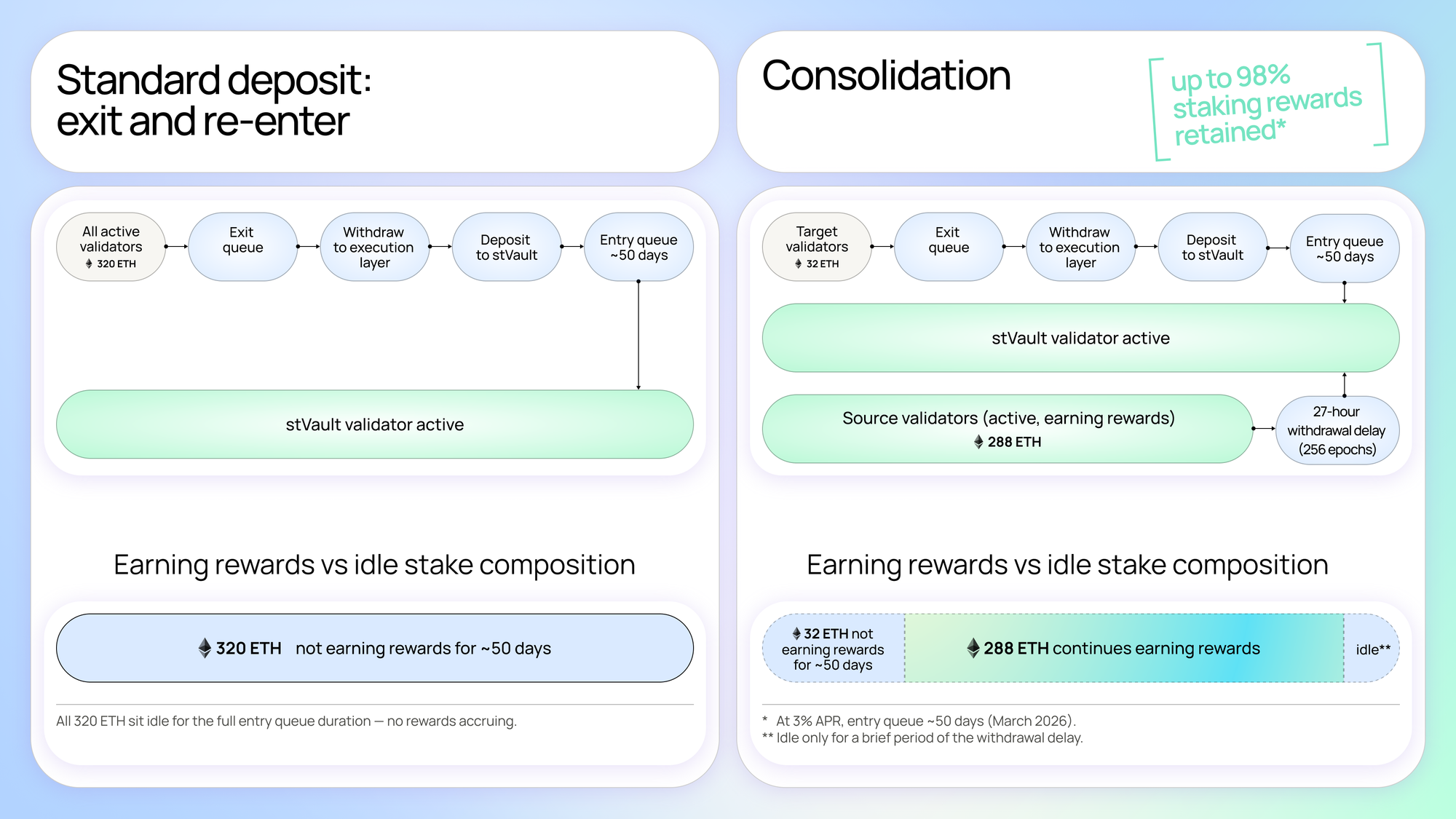
The beauty of the Consolidation mechanism lies in its elegant approach to minimizing downtime. When Consolidation is initiated, the source validators, which hold the ETH intended for migration, do not immediately cease operation. Instead, they continue to actively earn rewards up until their designated exit epoch. This is a critical distinction from the traditional method, where an exit immediately renders the ETH unproductive.
Following the source validator’s exit epoch, the stake enters a brief idle period, specifically the ~27-hour withdrawal delay (equivalent to 256 epochs). This delay is a standard part of the withdrawal process to ensure network stability and finality. Crucially, once this relatively short delay concludes, the balance is transferred directly to the target stVaults validator, which then immediately begins earning rewards. The only ETH that experiences the extended idle period associated with the long entry queue is the initial, minimal deposit required to activate the target stVaults validator(s). All other ETH being consolidated remains productive for nearly the entire duration of the target validator’s wait in the entry queue.
Let’s illustrate this with the examples provided in the original context, expanded for clarity:

-
Scenario 1: Migrating 10 Validators (320 ETH)
- Traditional Method: All 320 ETH would be withdrawn from 10 existing validators, then re-deposited into a new stVaults validator. This means 320 ETH would be idle for the cumulative duration of the exit queue, the withdrawal sweep, and the 50+ day entry queue. Assuming a conservative 3% APR, over 50 days, this could mean losing approximately 320 ETH (0.03/365) 50 = ~1.3 ETH in rewards.
- Consolidation Method: The operator first exits one validator (32 ETH) and uses this to make the initial deposit for a single stVaults target validator. This 32 ETH is then subject to the 50+ day entry queue. However, the remaining nine validators (288 ETH) continue to earn rewards throughout this 50-day waiting period. Once the target stVaults validator activates, the consolidation of the remaining 288 ETH begins. These source validators continue earning until their exit epoch, and only experience the ~27-hour withdrawal delay before their balance is transferred to the active stVaults validator. The result is one stVaults validator with a 320 ETH effective balance, with only 32 ETH (10% of the total stake) having been idle during the long queue. The rewards preserved are significant.
-
Scenario 2: Migrating 100 Validators (3,200 ETH)
- Traditional Method: All 3,200 ETH would be idle for the full 50+ day entry queue, plus exit queue times. At a 3% APR, this could mean losing approximately 3,200 ETH (0.03/365) 50 = ~13.15 ETH in rewards.
- Consolidation Method: Under EIP-7251, a single validator can hold up to 2,048 ETH. Thus, for 3,200 ETH, two target stVaults validators are needed (3,200 / 2,048, rounded up). The operator would exit two validators (64 ETH total), depositing this 64 ETH to create the two stVaults target validators. Both targets enter the queue simultaneously, meaning only one long waiting period. The remaining 98 validators (3,136 ETH) continue earning rewards for the entire ~50-day period. Once the targets activate, consolidation occurs, with the 3,136 ETH experiencing only the ~27-hour delay. In this case, only 64 ETH (2% of the total stake) is idle during the long queue. This approach preserves roughly 12 ETH in rewards compared to withdrawing and re-depositing everything, a substantial saving for a large operator.
This stark difference in idle capital periods highlights Consolidation’s immense value proposition. It effectively compartmentalizes the idle time, isolating it to a small fraction of the total stake, rather than the entire amount.
The Strategic Advantage for stVaults Users and Institutional Adoption
The introduction of Consolidation is particularly impactful for institutions and large-scale operators who are increasingly looking to participate in Ethereum staking through professional-grade solutions like stVaults. These entities prioritize capital efficiency, risk management, and seamless integration with their existing financial infrastructure. stVaults addresses these needs by offering:
- Enhanced Liquidity: Through stETH, allowing staked assets to remain liquid and usable in DeFi.
- Operational Efficiency: Streamlined management of validator operations, reducing overhead.
- DeFi Integrations: Opportunities to leverage staked assets in various decentralized finance protocols for additional yield or utility.
Before Consolidation, the trade-off was stark: embrace stVaults’ advantages but incur significant opportunity costs during migration. With Consolidation, this barrier is largely removed. Institutions can now transition their existing stake into stVaults with minimal disruption to their earnings stream. This reduced friction is expected to accelerate institutional adoption of liquid staking solutions and, by extension, Ethereum staking itself. It demonstrates a maturation of the Ethereum staking ecosystem, making it more appealing and accessible to sophisticated financial players.
Practical Implementation: Scaling Consolidation
The design of EIP-7251 allows for a maximum effective balance of 2,048 ETH per single validator. This means that for operations exceeding this threshold, multiple target validators will be required. The calculation is straightforward: the total amount of ETH to be consolidated is divided by 2,048, and the result is rounded up to determine the number of necessary target validators. This scalability ensures that even the largest stakers can benefit from the consolidation mechanism.

The process, as outlined in the examples, involves strategically initiating a minimal number of target validators, letting them queue up, and then consolidating the bulk of the stake once they are active. This phased approach, facilitated by EIP-7251, is a testament to the Ethereum community’s commitment to building a robust and user-friendly staking environment.
Perspectives from the Ecosystem
While direct quotes are not provided, the implications of EIP-7251 are clear and widely anticipated by the Ethereum community. Developers at Lido and other liquid staking protocols would likely emphasize the importance of such innovations for the long-term health and growth of the staking ecosystem. An Ethereum Foundation researcher might highlight EIP-7251 as a crucial step towards optimizing network resource utilization and improving the economic incentives for validators.
"This mechanism is a significant leap forward in improving the capital efficiency of Ethereum staking," an unnamed Lido developer might state. "It directly addresses a pain point for large-scale operators and institutions, allowing them to transition to more advanced staking solutions like stVaults without sacrificing weeks of potential rewards. This will undoubtedly drive further adoption and strengthen the network."
Similarly, an institutional staker would likely welcome the change. "For us, every day our capital is idle represents a direct financial loss," an inferred representative from an institutional staking fund might comment. "The Consolidation mechanism significantly de-risks the migration process to platforms offering advanced features, making the decision to move to solutions like stVaults a much clearer one." These sentiments underscore the practical and strategic importance of EIP-7251.
Requirements and Considerations
While highly beneficial, the Consolidation mechanism comes with specific requirements and limitations designed to maintain network security and stability. Key among these is that source validators must have been active for a minimum of 256 epochs (approximately 27 hours) before they can be used as a consolidation source. This ensures a level of maturity and stability for the validators involved in the transfer. Operators must also possess standard withdrawal credentials for their active validators to utilize them as consolidation sources. Full details, including a comprehensive step-by-step guide and any other technical prerequisites, are available in the official Lido Docs for stVaults consolidation. These guidelines are crucial for operators to ensure a smooth and successful migration process.
Broader Implications for Ethereum’s Staking Landscape
The introduction of EIP-7251 and the Consolidation mechanism carries significant broader implications for the Ethereum staking ecosystem:
- Increased Capital Flow: By reducing the opportunity cost of staking and migrating, Consolidation is likely to encourage more capital to flow into Ethereum staking, enhancing network security.
- Enhanced Institutional Participation: The improved capital efficiency and streamlined migration process make Ethereum staking more attractive to institutional investors and large-scale operators who demand optimized returns and minimal downtime for their assets.
- Strengthening Liquid Staking Protocols: Innovations like Consolidation strengthen the value proposition of liquid staking derivatives and platforms like stVaults, fostering their growth and further integrating them into the broader DeFi ecosystem.
- Improved Network Decentralization (Potentially): By making it easier for diverse operators to manage and optimize their stake, it could indirectly support a more diverse and decentralized validator set over time.
- A Maturing Ecosystem: This development signifies a maturing Ethereum ecosystem, continually refining its mechanisms to better serve its participants and address real-world operational challenges. It showcases a commitment to iterative improvement and user-centric design.
Looking Ahead: The Future of Efficient Staking
The Consolidation mechanism introduced with EIP-7251 is more than just a technical upgrade; it’s a strategic enhancement that fundamentally alters the economics of Ethereum staking migration. By drastically reducing idle capital and preserving staking rewards, it removes a significant barrier for operators and institutions seeking to leverage advanced liquid staking solutions like stVaults. As Ethereum continues to evolve, such innovations will be crucial in fostering a robust, efficient, and accessible staking environment for all participants. The Pectra upgrade, with EIP-7251 at its core, marks a pivotal moment in making Ethereum staking not just secure, but also supremely capital-efficient.
For those interested in exploring this mechanism further or initiating a migration, comprehensive technical documentation is available in the stVaults consolidation guide. Additionally, the stVaults team remains available for direct inquiries and support, ensuring a smooth transition for all interested parties.