Lina Irawan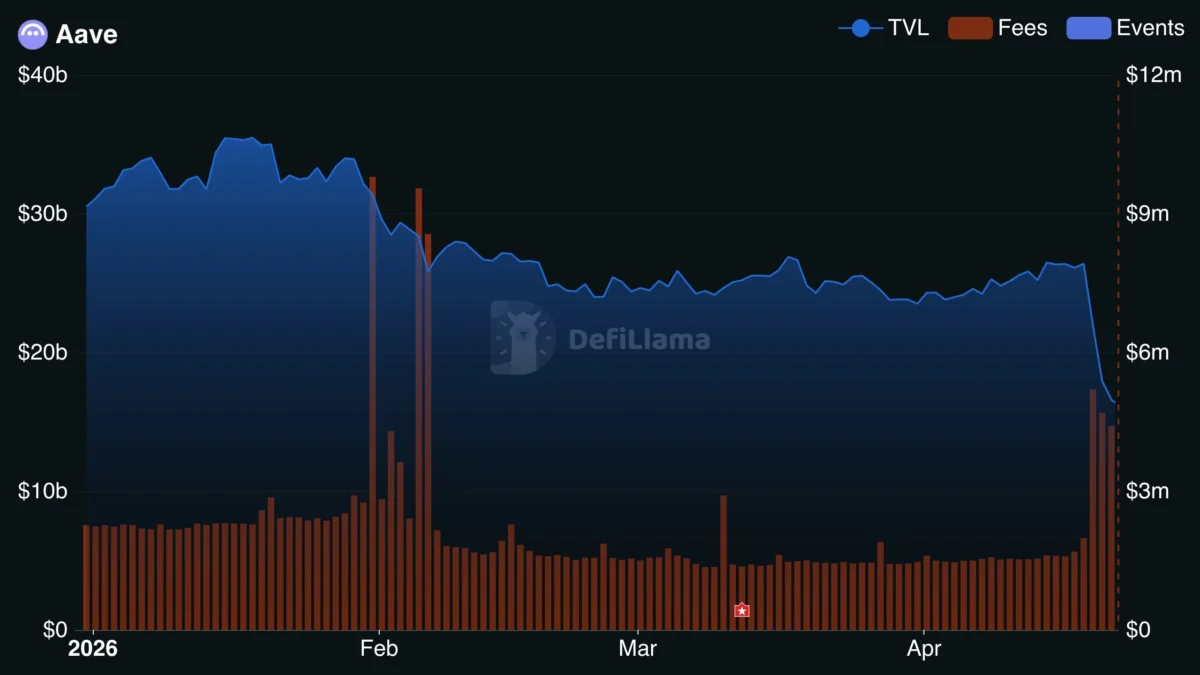
In the wake of a significant exploit on the decentralized finance (DeFi) platform KelpDAO, the total value locked (TVL) in the DeFi market has experienced a dramatic contraction of approximately $13 billion within a mere 48-hour period. The incident, which occurred on April 18, 2026, and resulted in the direct loss of roughly $290 million, has been identified as the largest decentralized finance hack of the year. This breach has not only impacted KelpDAO directly but has also instigated a cascade of liquidity withdrawals, notably affecting major lending protocols such as Aave, where a substantial portion of the exploited assets had been utilized as collateral. The repercussions of this event underscore the interconnectedness of DeFi protocols and the potential for systemic risk when vulnerabilities are exploited.
DeFi TVL Plummets Amidst Widespread Liquidity Flight
Data aggregated by DefiLlama reveals a stark decline in the total DeFi Total Value Locked (TVL). On April 18, the market’s TVL stood at approximately $99.4 billion. However, within two days, this figure had fallen to an estimated $86.2 billion, signifying a reduction of over $13 billion. The Ethereum ecosystem, which typically represents a significant portion of DeFi activity, bore the brunt of this outflow. Its TVL on Ethereum alone plummeted from around $56.5 billion on April 18 to nearly $46 billion by April 20, marking a substantial decline of nearly $10 billion within this specific blockchain environment.
This sharp decrease in TVL is not primarily attributed to spot market sell-offs of underlying digital assets. Instead, the data suggests that capital is actively being withdrawn from higher-risk structures, specifically those involved in restaking and cross-chain bridging mechanisms. This indicates a flight to safety, as investors and users seek to de-risk their portfolios in the face of heightened security concerns. The rapid withdrawal of liquidity points to a broader sentiment of caution pervading the DeFi landscape following the KelpDAO breach.
Unpacking the KelpDAO Exploit: A Vulnerability in Cross-Chain Communication
The root cause of the KelpDAO exploit lies in a vulnerability within its LayerZero-based rsETH bridge path. Specifically, a "1-of-1 DVN" (Data Verification Network) validation configuration was exploited. This configuration, when improperly secured, allowed for the acceptance of a fraudulent cross-chain message that did not correspond to an actual burn transaction on the originating chain. This critical flaw enabled the illicit release of approximately 116,500 rsETH tokens from the Ethereum-side adapter. The consequence was the creation of an unbacked surplus of these tokens on associated chains, effectively diluting the value and integrity of the restaked Ether derivative.
The exploit’s mechanism highlights a critical aspect of DeFi security: the reliance on secure cross-chain communication protocols. LayerZero, a popular interoperability solution, was implicated in this incident due to the misconfiguration of its verification process. The absence of a corresponding burn transaction meant that the exploited rsETH could be minted and moved across chains without the backing of the underlying staked Ether, leading to the subsequent financial losses and market instability.
Chronology of the Event and Market Reaction
The incident unfolded rapidly, with the exploit occurring on April 18, 2026. Initial reports of the hack and the direct loss of approximately $290 million quickly surfaced. This direct financial impact, while substantial, was soon overshadowed by the broader market reaction.

- April 18, 2026: The KelpDAO exploit is identified, with initial estimates of direct losses around $290 million. The vulnerability in the LayerZero-based rsETH bridge is reported.
- April 18-20, 2026: A significant wave of liquidity withdrawals begins across the DeFi market. Total DeFi TVL experiences a sharp decline of over $13 billion. Ethereum’s TVL alone drops by nearly $10 billion.
- April 19-20, 2026: Lending protocols, particularly Aave, see substantial outflows as users withdraw collateral and close positions related to rsETH.
- April 20, 2026: LlamaRisk publishes a detailed incident report concerning the rsETH situation on Aave, providing insights into the flow of exploited assets and potential bad debt.
The speed at which the market reacted underscores the interconnected nature of DeFi. The exploit on KelpDAO served as a catalyst, triggering a broader reassessment of risk and prompting a swift deleveraging process across various protocols.
Liquidity Unwind: The Domino Effect of the Kelp Exploit
The direct financial loss of $290 million from the KelpDAO exploit represents only a fraction of the over $13 billion TVL drop observed across the DeFi market. The vast majority of this market volatility can be attributed to the subsequent process of position unwinding and liquidity extraction. rsETH, the token at the center of the exploit, is a widely utilized asset within DeFi. It serves as collateral for borrowing other cryptocurrencies, such as Ether (ETH) and stablecoins, which are then reinvested into various yield-generating strategies.
When the security of rsETH was compromised, these intricate chains of related positions were immediately threatened. To mitigate potential losses and manage risk, investors and protocols were compelled to close these positions. This process involved:
- Liquidity Withdrawals from Lending Protocols: As users sought to reclaim their collateral and exit exposed positions, significant amounts of liquidity were withdrawn from platforms like Aave.
- Reduced Leverage: The deleveraging process led to a reduction in overall leverage within the market, as leveraged positions were unwound to prevent cascading liquidations.
- Defensive Portfolio Restructuring: Investors rebalanced their portfolios, moving capital away from perceived high-risk assets and towards more secure alternatives.
This proactive deleveraging occurred even before a large-scale wave of forced liquidations could take hold. Data from Coinglass indicated that total liquidations across the market in the 24 hours following the exploit reached approximately $254 million. While this figure reflects increased volatility, it is notably lower than what has been observed during previous periods of extreme market panic and forced liquidations. This suggests that the majority of capital exiting DeFi during this time was a result of conscious decisions to reduce risk, rather than forced sales due to margin calls.
Aave Becomes the Epicenter of Market Shock Absorption
The lending protocol Aave found itself at the forefront of the market’s reaction due to the significant exposure it had to the exploited rsETH. A substantial portion of the illicitly obtained rsETH was channeled into Aave as collateral. According to an incident report published by LlamaRisk on April 20, approximately 89,567 rsETH, valued at roughly $221.39 million, out of the total 116,500 rsETH withdrawn, was deposited into Aave.
Following this deposit, the attacker proceeded to borrow approximately 82,650 WETH, valued at around $190.86 million, along with a small amount of wstETH. Crucially, these borrowed positions maintained health factors in the range of 1.01 to 1.03, placing them precariously close to the liquidation threshold. This proximity to liquidation amplified the perceived risk within the Aave ecosystem.
In response to this heightened risk, Aave’s risk management team acted swiftly. They took the decisive step of freezing all rsETH and wrsETH reserves within the protocol and immediately reduced the Loan-to-Value (LTV) ratio for these assets to zero. This action effectively prevented any new positions from being opened using rsETH as collateral, thereby containing further risk accumulation. Additionally, several related WETH markets were temporarily frozen, and interest rate models were adjusted to help alleviate liquidity pressures within the system. Aave’s official statements confirmed that the protocol itself had not been directly compromised; the incident originated entirely from the external, compromised rsETH asset.

Despite not being the origin of the exploit, Aave’s TVL experienced a dramatic decline. Prior to the incident, Aave’s TVL was approximately $26.3 billion. In the immediate aftermath, it dropped to $20 billion, and subsequently further retreated to around $16.4 billion. This sharp contraction in TVL highlights how a single, highly exposed asset can exert significant pressure on even the largest and most established DeFi protocols.
Assessing the Potential for Bad Debt
The precise amount of potential bad debt on Aave remains a complex calculation, heavily influenced by how the unbacked rsETH is ultimately handled and the specific loss allocation mechanisms that will be employed. LlamaRisk’s modeling scenarios suggest that the total bad debt on Aave could range from approximately $123.7 million to $230.1 million. This wide range depends on crucial factors, such as whether losses are distributed uniformly across all affected assets or concentrated specifically on the rsETH assets held on Layer 2 scaling solutions.
The impact of such an event could be significantly amplified on Layer 2 networks like Mantle, Arbitrum, and Base. These blockchains generally possess lower liquidity compared to Ethereum’s mainnet, and their position buffers are more limited. This means that a similar magnitude of unbacked assets or collateral devaluation could have a more severe and rapid cascading effect on these ecosystems, potentially leading to larger percentage losses and greater instability.
The Market at a Crossroads: Navigating Future Risks
In the immediate aftermath of the KelpDAO exploit and the subsequent market correction, positions directly related to rsETH on Aave have largely been ring-fenced. There have been no immediate, direct protocol-level impacts reported stemming from these isolated positions. However, the outflow of capital from Aave, which holds the majority of the exposure related to the exploited rsETH, continues.
The future trajectory of the DeFi market hinges on several factors. If the value of the compromised rsETH continues to decline, or if the mechanisms for allocating losses from the exploit create additional pressure on Layer 2 markets, the ripple effects could extend further across the lending sector. This could manifest as a broader decline in collateral values and a tightening of liquidity, potentially leading to further deleveraging and market contraction. The KelpDAO incident serves as a stark reminder of the inherent risks within the interconnected DeFi ecosystem and the critical importance of robust security measures, particularly concerning cross-chain interoperability and asset validation. The market now stands at a short-term inflection point, where its ability to absorb such shocks and implement effective risk mitigation strategies will be rigorously tested.